Drip Irrigation in Telangana: Which Method Is Better for Your Farm?
Drip Irrigation in Telangana: Water is one of the most important factors in successful farming. Choosing the right irrigation method can make a real difference to how efficiently a farmer uses water, manages labour and maintains crop growth.
In Telangana, where rainfall and water availability can vary from season to season, selecting a suitable irrigation system is an important decision for agricultural landowners.
Two commonly used methods are drip irrigation and traditional irrigation. Both have their own advantages, limitations and suitable applications.
But which one is better for your agricultural land?
In this guide, we explain how these systems work, compare their water usage, installation and maintenance requirements, and help you understand which method may suit different crops and farming conditions.
1. What Is Drip Irrigation in Telangana and How Does It Work?
Drip irrigation is a method of supplying water directly to the root zone of plants through a network of pipes, tubes and small outlets called emitters or drippers.
Instead of spreading water across the entire field, the system delivers it slowly and in controlled quantities near the plants.
This helps maintain soil moisture around the roots and reduces unnecessary water application.
Main Components of a Drip Irrigation System
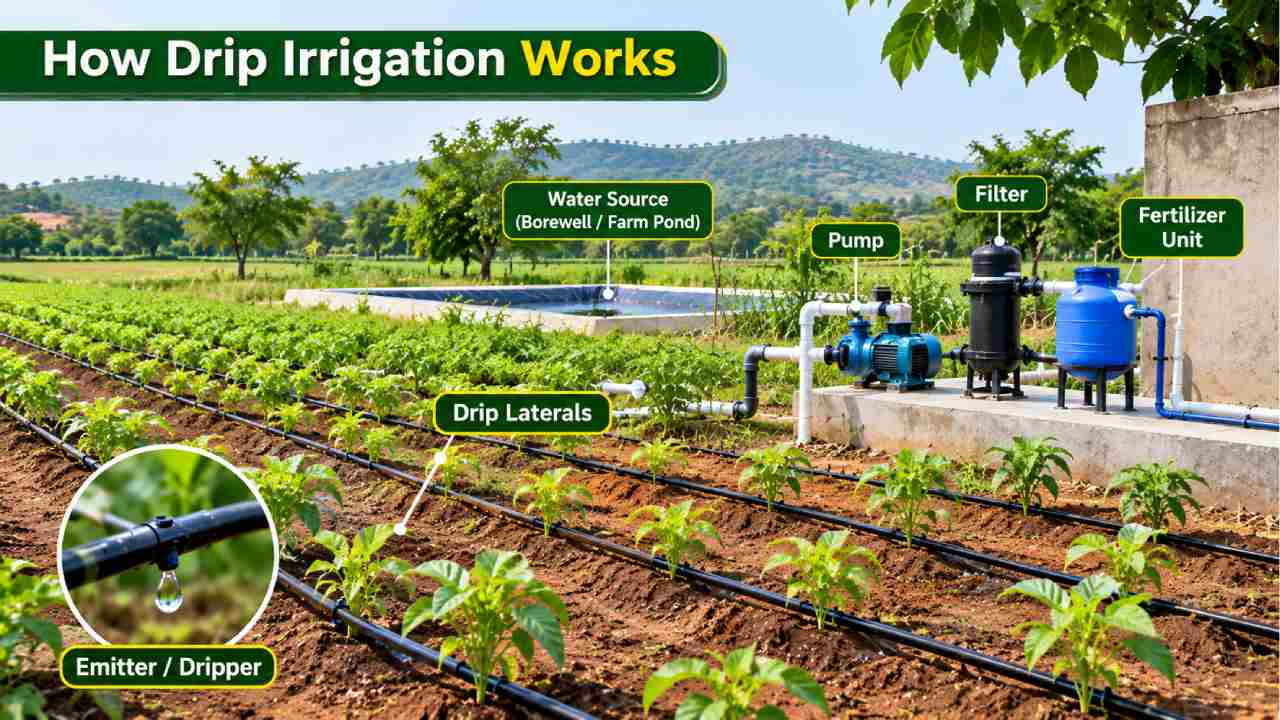
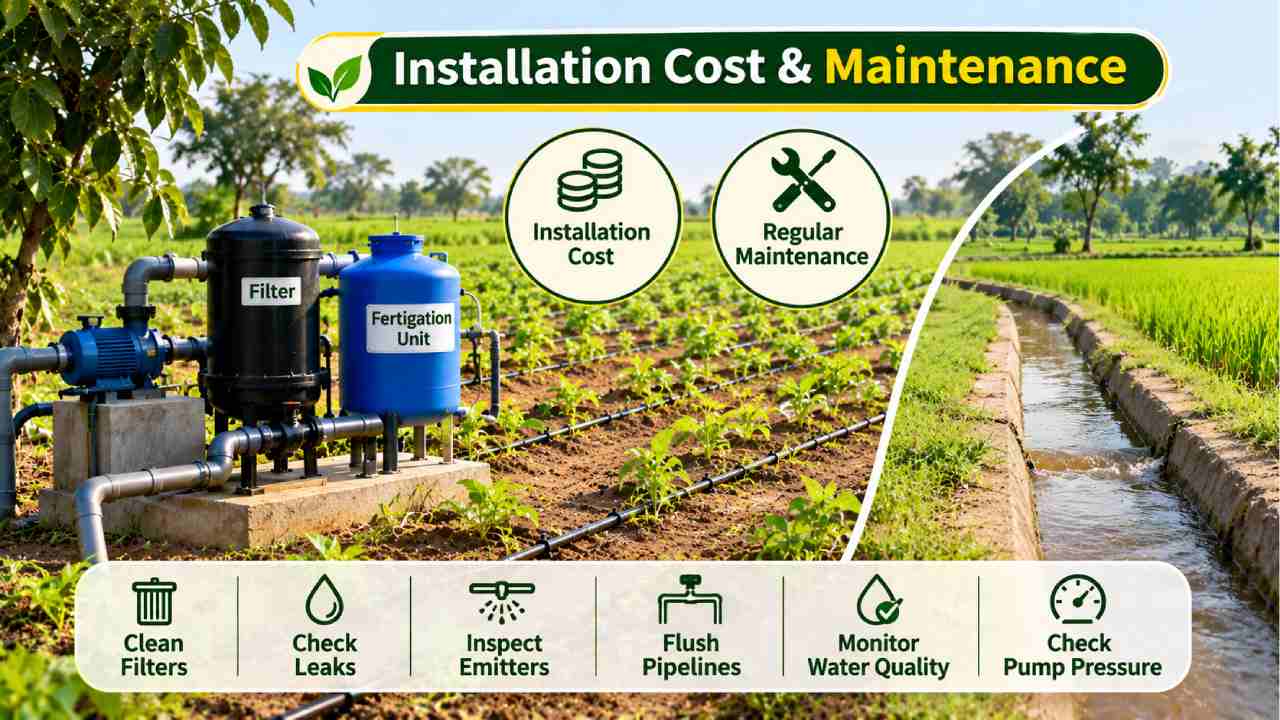
A typical system includes:
- Water source: A borewell, open well, farm pond or another suitable source.
- Pump: Supplies water at the required pressure.
- Filter: Removes sand, dirt and other particles that may block the emitters.
- Mainline and sub-main pipes: Carry water across different sections of the field.
- Laterals: Smaller pipes placed along crop rows.
- Emitters: Release water near individual plants.
- Fertilizer unit: Allows suitable water-soluble fertilizers to be supplied through the irrigation system.
The design depends on the crop, plant spacing, soil type, water quality, water availability and field layout.
How Does It Work?
Water moves from the source through the filter and pipe network. It then reaches the emitters, which release water close to the plant roots.
Farmers can control how much water is supplied and how frequently irrigation takes place.
This makes drip irrigation useful for orchards, vegetables and many other crops where controlled water application is important.
2. Drip Irrigation in Telangana vs Traditional Irrigation: Key Differences
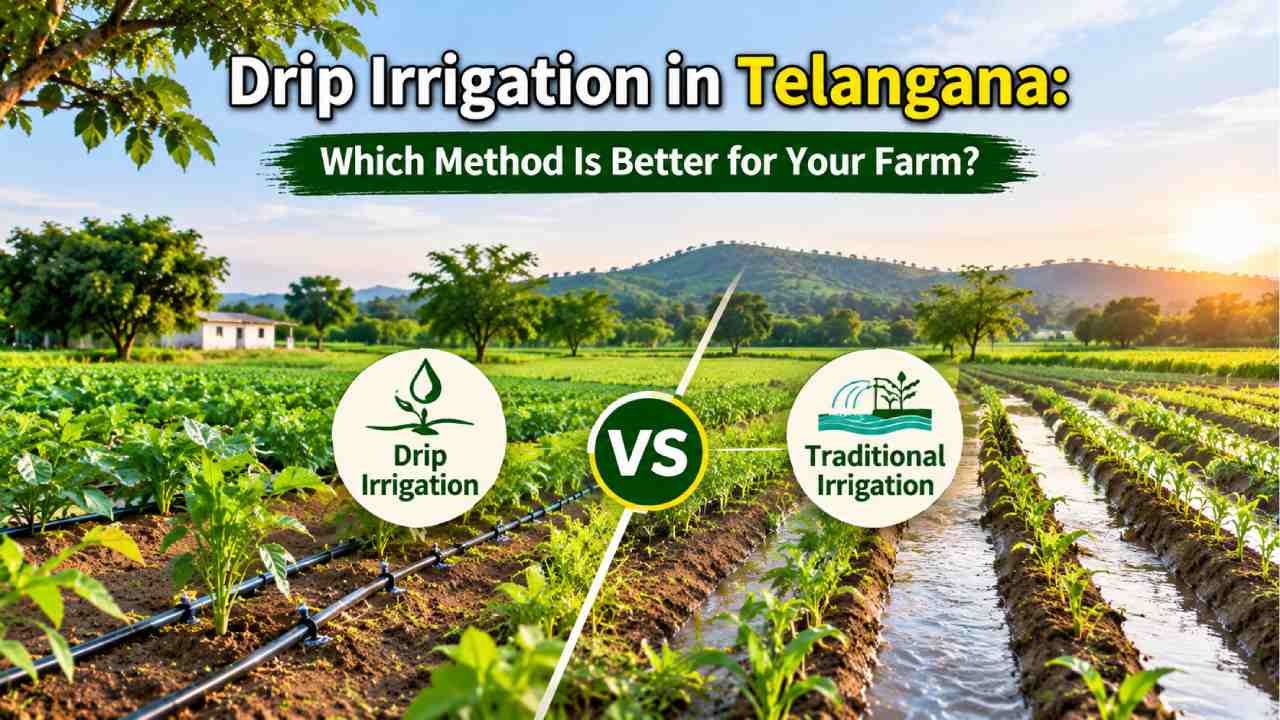
Traditional irrigation generally refers to methods such as flood or surface irrigation, where water is distributed across the field through channels, furrows or field flooding.
The method is widely used in agriculture, particularly where field layout, water availability and crop requirements make it suitable.
However, the amount of water required and the level of control can differ significantly between irrigation methods.
Comparison of Both Irrigation Methods
| Factor | Drip Irrigation | Traditional Irrigation |
|---|---|---|
| Water application | Directly near plant roots | Distributed across the field |
| Water control | More precise | Depends on field layout and water flow |
| Water loss | Can reduce runoff and evaporation losses | May have higher losses depending on conditions |
| Installation | Requires pipes, filters and emitters | May use channels, furrows or field preparation |
| Maintenance | Filters and emitters need regular cleaning | Channels and field water flow need maintenance |
| Labour | Can reduce routine irrigation work | May require more manual supervision |
| Fertilizer application | Fertigation is possible | Usually applied separately |
| Initial investment | Generally higher | Can be lower where infrastructure already exists |
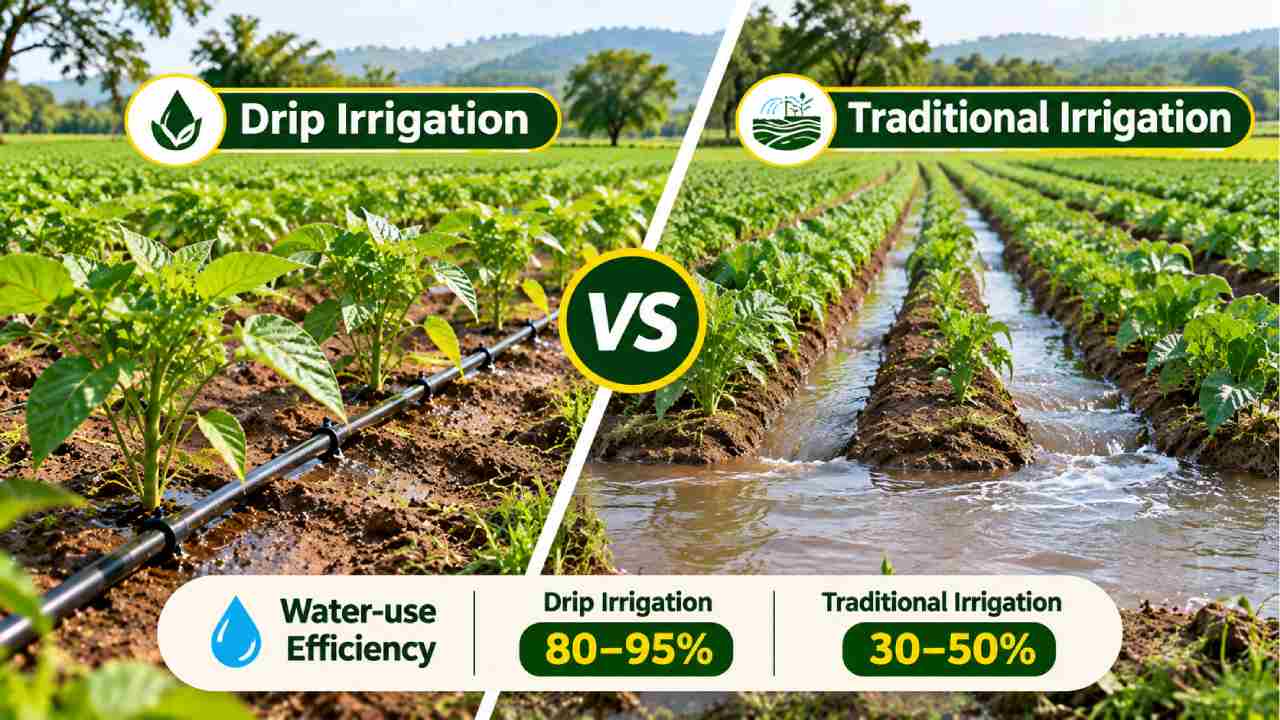
Which Method Uses Water More Efficiently?
Water efficiency is one of the major reasons farmers consider drip irrigation.
According to the Indian Council of Agricultural Research information shared by the Government of India, micro-irrigation systems, including drip irrigation, can achieve water-use efficiency of around 80–95%, compared with approximately 30–50% for conventional flood irrigation.
These are indicative figures. Actual efficiency depends on the system design, crop, soil, irrigation management and field conditions.
For farmers with limited water resources, a well-designed drip system may help make better use of available water.
3. Drip Irrigation in Telangana: Which Crops Are Suitable?
Not every crop requires the same amount of water or the same irrigation method.
The right choice depends on crop spacing, root development, soil conditions, water availability and farming practices.
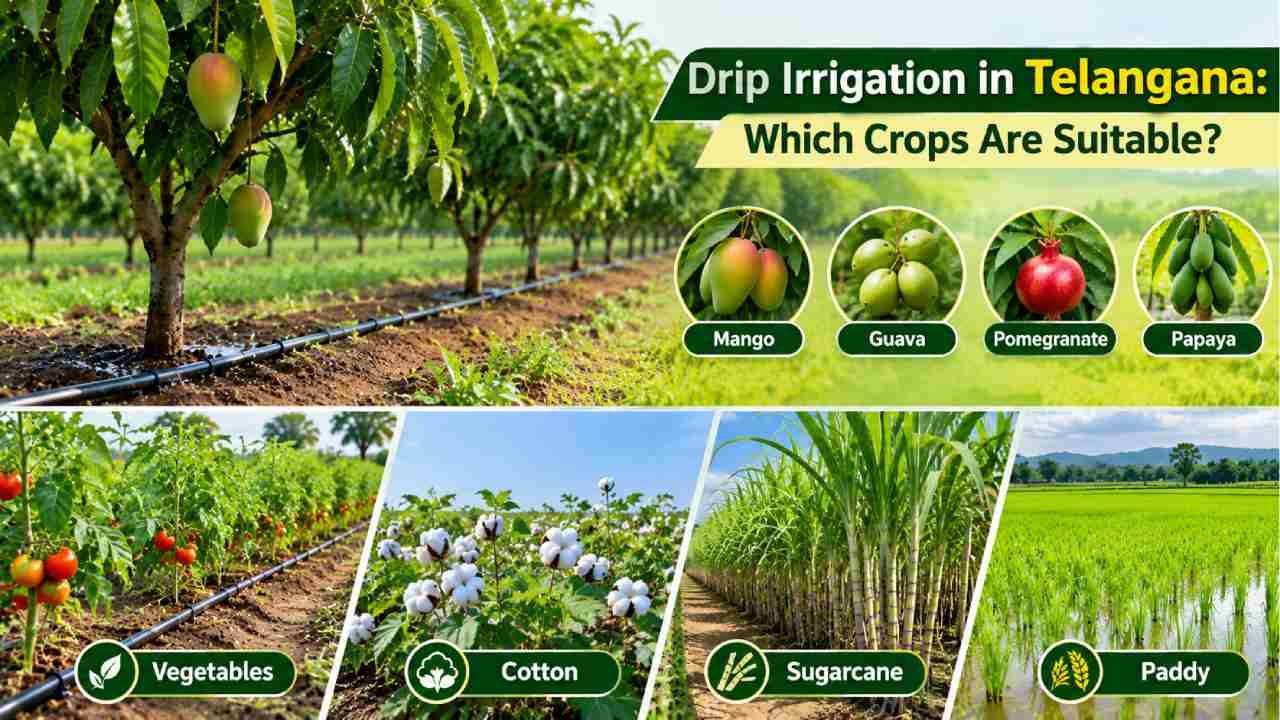
Here are some examples of crops where drip irrigation may be useful.
Fruit Orchards
Drip irrigation is commonly used for fruit crops such as:
- Mango
- Guava
- Papaya
- Sweet lime (Mosambi)
- Pomegranate
For orchards, individual emitters can supply water near each plant. The number and spacing of emitters should be planned according to plant age, canopy size and water requirement.
Vegetable Crops
Vegetables such as tomato, chilli, brinjal, cucumber and other row crops can benefit from controlled irrigation.
Inline drip systems are often considered for closely spaced crops, depending on the planting arrangement.
Commercial and Field Crops
Drip systems may also be suitable for crops such as:
- Cotton
- Sugarcane
- Turmeric
- Maize
The choice of system should be based on crop spacing, soil conditions and the availability of technical support.
What About Traditional Irrigation?
Traditional irrigation may still be suitable for crops and fields where surface water distribution is practical.
For example, paddy cultivation is commonly associated with surface irrigation and field flooding. The appropriate method depends on the crop variety, soil, water supply and local cultivation practices.
A farmer should not select an irrigation system simply because it is popular. The system must match the actual farming requirement.
For more information about crop selection, read our guide on best crops to grow on agricultural land in Telangana.
4. Drip Irrigation in Telangana: Installation Cost and Maintenance
Before installing an irrigation system, farmers should understand both the initial investment and the regular maintenance requirements.
Installation Cost
The cost of a drip irrigation system is not the same for every farm.
It may depend on:
- Total land area.
- Type of crop and plant spacing.
- Water source and pumping requirements.
- Length and quality of pipes.
- Number and type of emitters.
- Filtration equipment.
- Fertigation requirements.
- Field shape and layout.
An orchard with widely spaced trees may require a different design from a vegetable field with closely spaced rows.
For this reason, farmers should get a field-specific quotation instead of relying on a general per-acre estimate.
Regular Maintenance
A drip system needs regular attention to work properly.
Important maintenance activities include:
- Clean filters according to the manufacturer’s recommendations.
- Check pipes for leakage or damage.
- Inspect emitters for blockages.
- Flush the pipelines periodically as recommended.
- Monitor water quality, especially where the source contains sand or dissolved salts.
- Check pump pressure and system performance.
- Replace damaged components when necessary.
Blocked emitters can result in uneven water supply. Regular inspection helps identify such problems early.
Is Traditional Irrigation Easier to Maintain?
Traditional irrigation may have fewer specialised components, particularly when an existing channel system is available.
However, channels may need cleaning, repairs and regular supervision to ensure proper water distribution.
The actual maintenance effort depends on the field and irrigation infrastructure.
5. Drip Irrigation in Telangana: Government Support and Subsidy Information
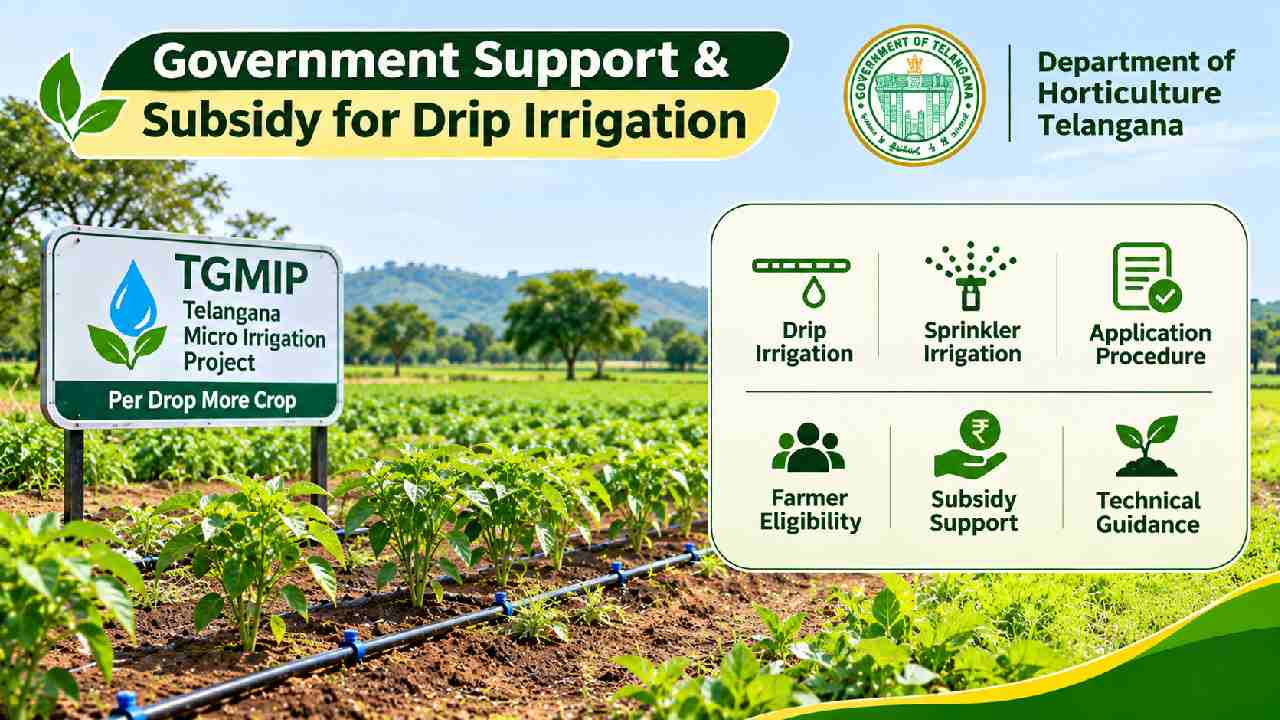
The Government of Telangana promotes micro-irrigation through the Telangana Micro Irrigation Project (TGMIP), under the Per Drop More Crop programme.
The programme supports the adoption of micro-irrigation technologies to improve water-use efficiency and agricultural productivity.
The Telangana Department of Horticulture provides information about:
- Drip irrigation systems.
- Sprinkler irrigation systems.
- Application procedures.
- Farmer eligibility.
- Approved micro-irrigation suppliers.
- Technical guidance and farmer support.
Subsidy eligibility and the amount of assistance can depend on the applicable government guidelines, farmer category, landholding, system type and current programme provisions.
Therefore, farmers should confirm the latest eligibility conditions and subsidy details directly with the Telangana Department of Horticulture before making an investment.
Where Can Farmers Get Official Information?
Farmers can refer to the Telangana Micro Irrigation Project website for programme information.
The department also provides an official FAQ on drip and sprinkler irrigation, including information about applications and technical aspects.
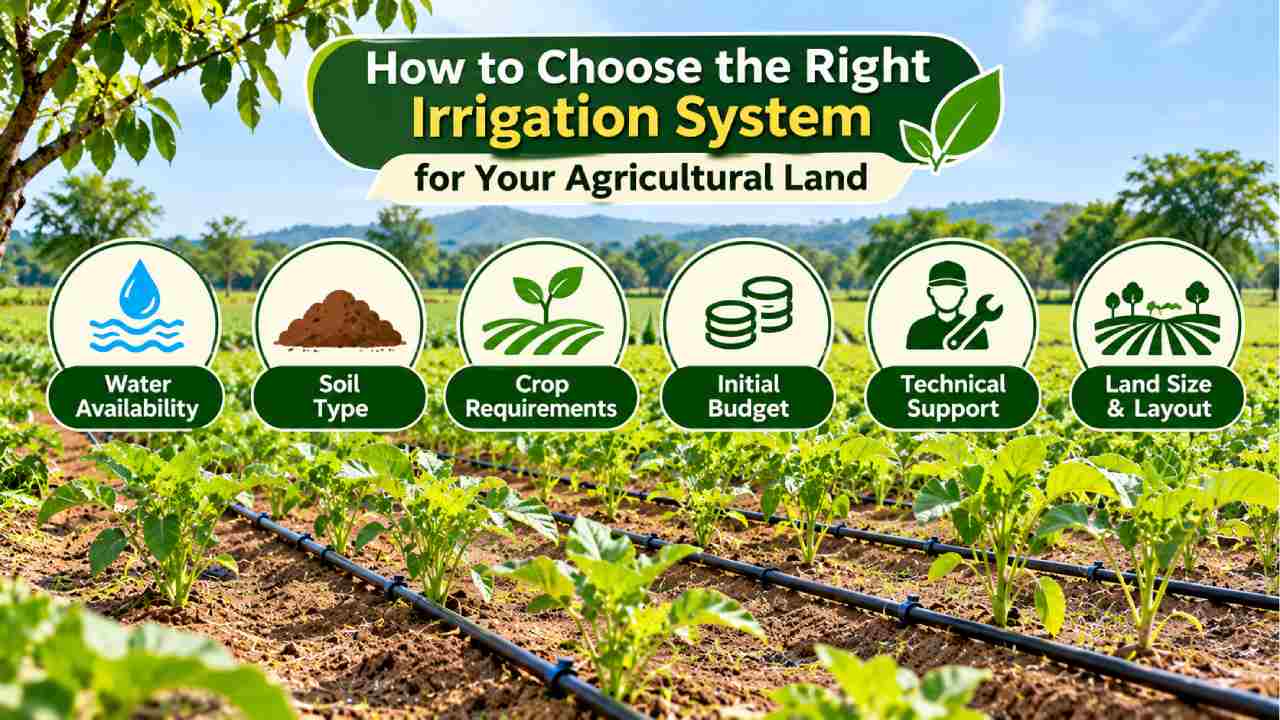
6. How to Choose the Right Irrigation System for Your Agricultural Land
Choosing between drip and traditional irrigation requires more than comparing installation costs.
Before making a decision, consider the following factors:
1. Water Availability
Understand how much water is available throughout the year.
Check the reliability of the borewell, open well, farm pond or other water source. A source that works during the rainy season may not provide the same supply during summer.
2. Soil Type
Sandy soils generally allow water to drain faster, while clay soils can retain moisture for longer.
The irrigation schedule should be adjusted to the soil’s water-holding capacity and drainage characteristics.
3. Crop Requirements
Different crops have different water needs.
Fruit orchards, vegetables and row crops may benefit from drip irrigation, while some other crops may be managed using suitable surface irrigation methods.
4. Initial Budget
Compare the cost of installing a new system with the cost of maintaining existing irrigation infrastructure.
Do not select a system based only on its initial price. Consider its expected operating and maintenance costs as well.
5. Availability of Technical Support
A drip irrigation system needs correct installation, pressure management and periodic maintenance.
Check whether trained technicians and replacement components are available in your area.
6. Land Size and Layout
The size, slope, shape and internal layout of the land can influence irrigation design.
A properly planned system helps distribute water more evenly across the field.
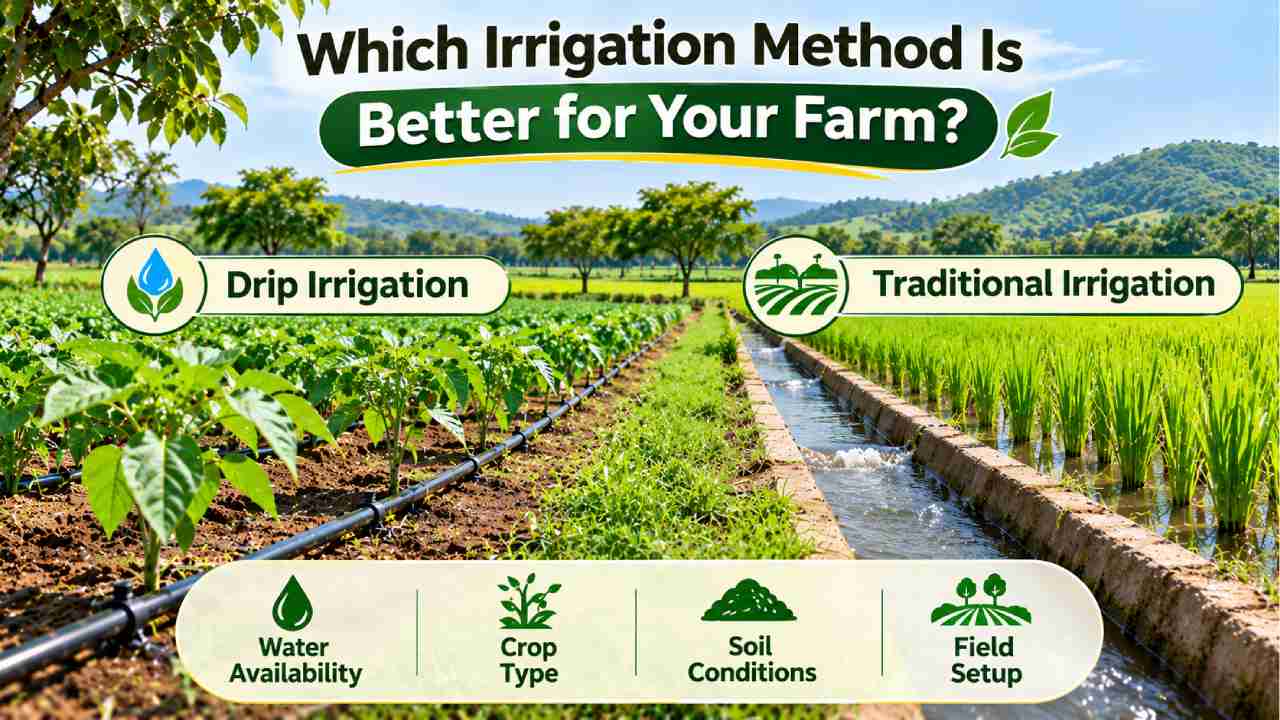
7. Which Irrigation Method Is Better for Your Farm?
There is no single answer that suits every agricultural property.
Drip irrigation may be a suitable option when:
- Water availability is limited.
- The farm has fruit orchards or row crops.
- Controlled water application is important.
- Fertigation is part of the farming plan.
- The farmer can maintain the required equipment.
Traditional irrigation may be suitable when:
- Existing surface irrigation infrastructure is available.
- The crop and soil conditions support the method.
- Sufficient water is available.
- The field can be irrigated efficiently through channels or furrows.
Some farms may also use a combination of irrigation methods for different crops or sections of the same property.
The best approach is to assess the actual water source, soil, crop and field conditions before deciding.
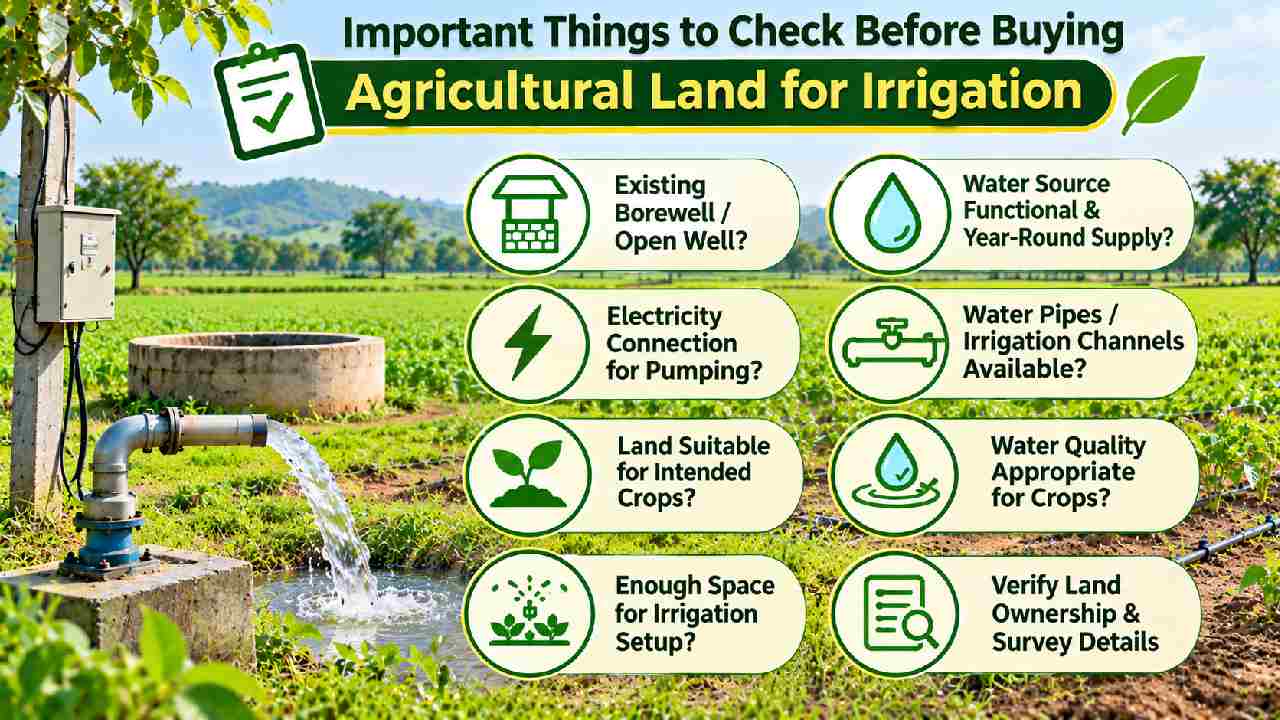
8. Important Things to Check Before Buying Agricultural Land for Irrigation
If you are planning to purchase agricultural land for cultivation, irrigation facilities should be part of your site inspection.
Do not depend only on verbal statements about water availability.
Check these points:
- Is there an existing borewell or open well?
- Is the water source functional?
- Is water available during the summer?
- Is there an electricity connection for pumping, where required?
- Are water pipes or irrigation channels already available?
- Is the land suitable for the crops you intend to grow?
- Is the water quality appropriate for the proposed crops?
- Is there enough space and access for installing an irrigation system?
It is also useful to understand the land’s ownership and survey details before making a purchase. Read our guide on records to check before buying agricultural land in Telangana.
If you own land but cannot visit it regularly, our guide on remote land management from Hyderabad explains why water monitoring and regular inspections matter.
Conclusion
Choosing the right irrigation system is an important part of planning successful agriculture.
Drip irrigation offers better control over water application and can help reduce water losses when properly designed and maintained. Traditional irrigation can also remain useful where crop requirements, soil conditions and existing infrastructure support it.
Before choosing either method, understand your water source, soil type, crop requirements, installation budget and maintenance needs.
For anyone planning to purchase agricultural land in Telangana, checking irrigation facilities is just as important as checking the land’s location and documents.
At Bhoomi Infrastructure, we believe that understanding the practical aspects of agricultural land ownership helps buyers make better-informed decisions. Whether you are planning an orchard, vegetable cultivation or long-term agricultural use, the right land and proper water planning can make a meaningful difference.
Sources and References
- Telangana Micro Irrigation Project – Department of Horticulture
- Telangana Micro Irrigation Project – Official FAQs
- Telangana Micro Irrigation Project – Operational Guidelines
- Press Information Bureau – Government of India: Micro-Irrigation and Water-Use Efficiency
Disclaimer
This article is intended for general educational purposes. Irrigation requirements, water savings, installation costs and crop suitability vary according to local conditions. Farmers should consult qualified agricultural or irrigation experts before selecting or installing an irrigation system. Subsidy details should always be confirmed through the latest official government guidelines.