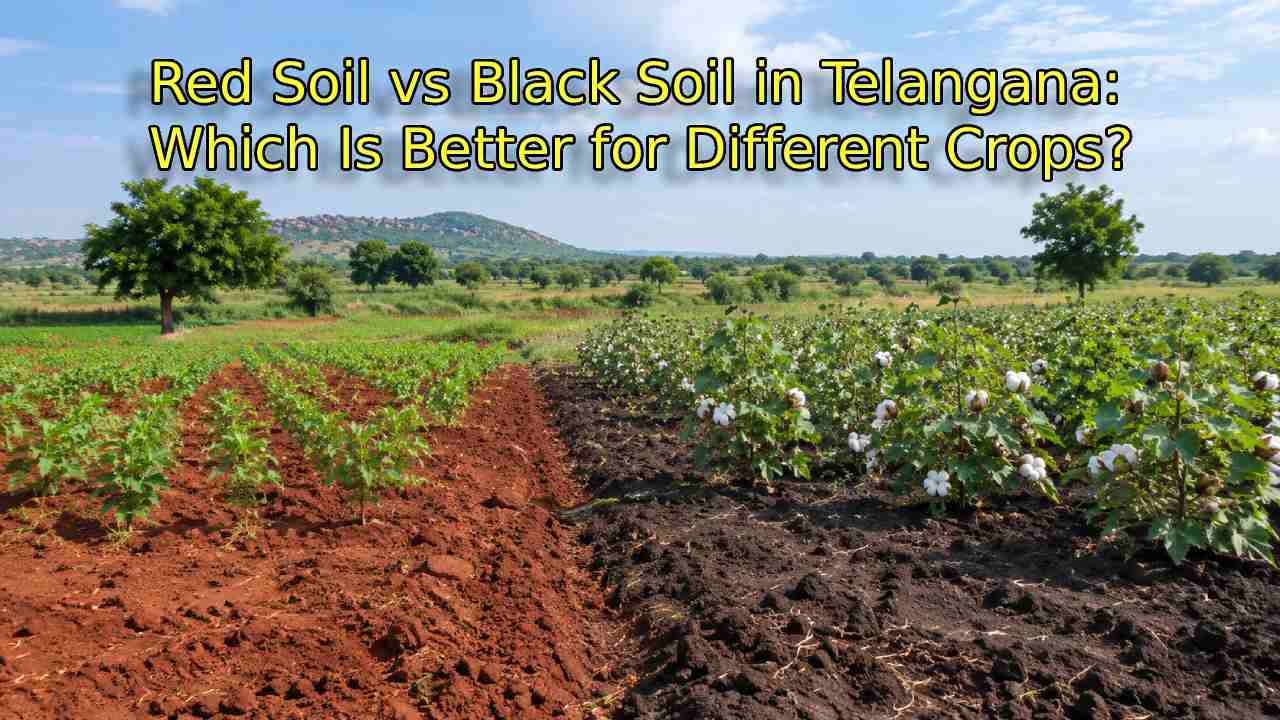
Red Soil vs Black Soil in Telangana: Which Is Better for Different Crops?
Red Soil vs Black Soil in Telangana: A practical guide to soil characteristics, water retention, drainage, crop suitability and soil testing for agricultural land buyers.
Telangana has different soil types that influence agricultural activities across the state. Among them, red soil and black soil are two important soil groups. Understanding Red Soil vs Black Soil in Telangana can help farmers and agricultural land buyers make informed decisions about crop selection, irrigation and land suitability.
Both soil types can support productive agriculture. However, they differ in texture, moisture retention, drainage and nutrient characteristics.
The important question is not simply which soil is better. It is which soil is suitable for your intended crop, based on its actual condition, water availability and local climate.
1. Red Soil vs Black Soil in Telangana: Understanding Red Soil
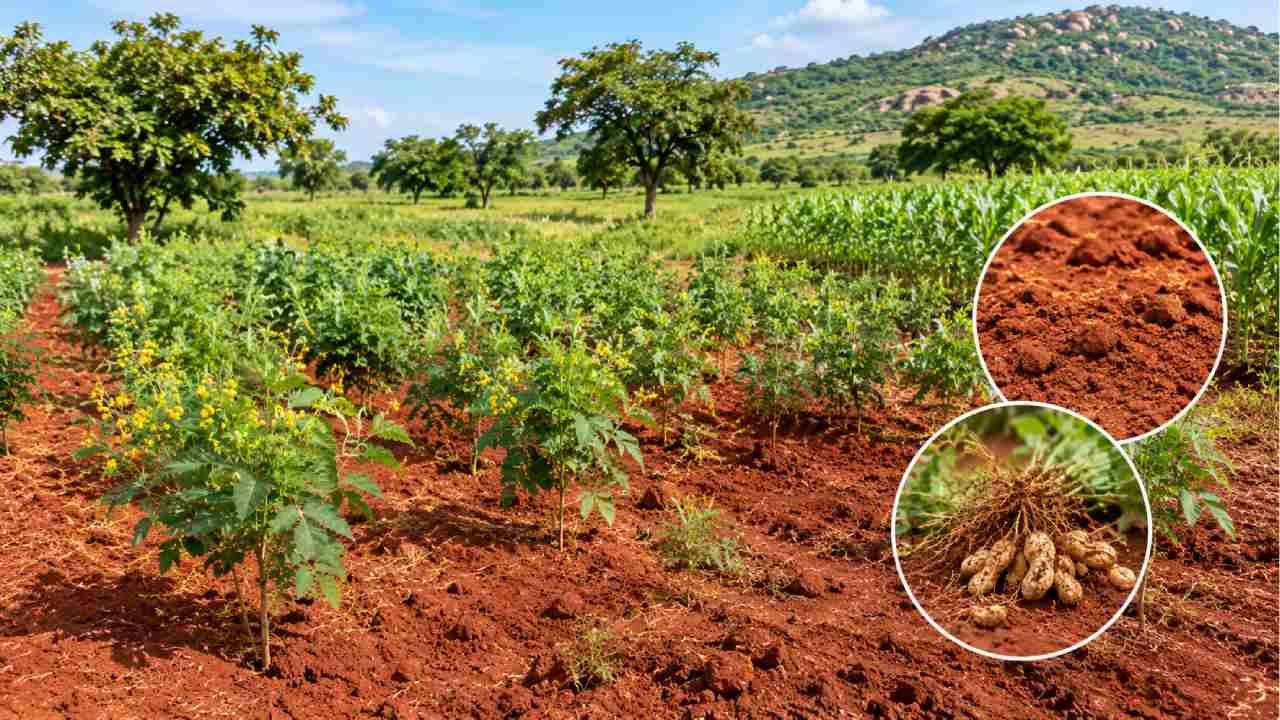
Red soil gets its reddish colour mainly from iron oxides present in the soil. It occurs in different forms, including red sandy loams, red gravelly soils and red clayey soils.
In Telangana, red soils are found across all three major agro-climatic zones, although their texture and depth vary by region.
Key characteristics of red soil:
- Often has a sandy, loamy or gravelly texture.
- Generally allows better drainage in lighter-textured varieties.
- May lose moisture relatively quickly, particularly in sandy soils.
- Organic carbon and nutrient levels can vary considerably.
- Soil fertility can be improved through suitable organic matter and nutrient management.
Crops that may be cultivated in suitable red soils:
- Red gram (Pigeon pea)
- Groundnut
- Green gram
- Castor
- Millets
- Maize
- Selected horticultural crops, depending on local conditions.
The suitability of these crops depends on soil depth, rainfall, irrigation, nutrient status and the crop variety selected.
2. Red Soil vs Black Soil in Telangana: Understanding Black Soil
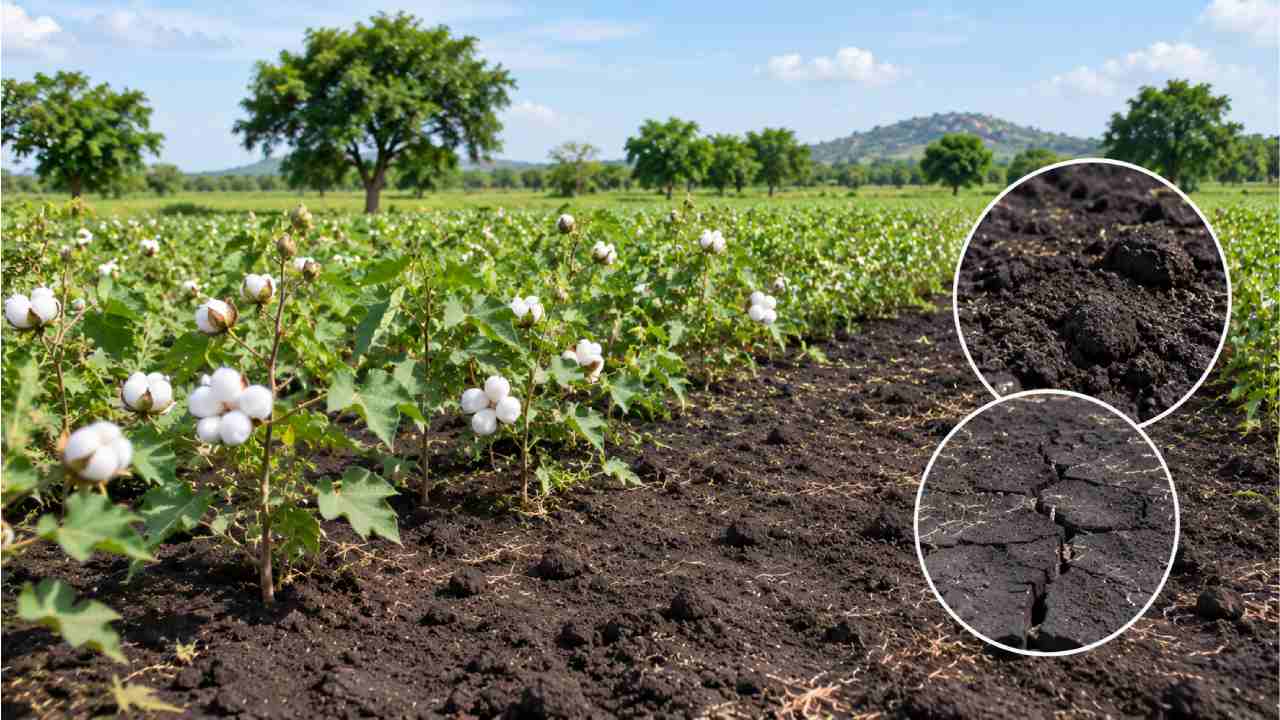
Black soil is commonly known as Regur soil or black cotton soil. It generally contains a higher proportion of clay and has good moisture-retention capacity.
One of its important characteristics is its shrink-and-swell behaviour. The soil can become sticky when wet and develop cracks during dry weather.
Key characteristics of black soil:
- Generally has a clay-rich texture.
- Retains moisture for longer periods than many sandy soils.
- Can become sticky and difficult to cultivate when excessively wet.
- May develop deep cracks during dry conditions.
- Heavy varieties can have drainage limitations.
- Nutrient availability varies and should be checked through soil testing.
Crops commonly associated with suitable black soils:
- Cotton
- Soybean
- Sorghum (Jowar)
- Pulses
- Sunflower
- Other suitable crops based on local conditions.
Black soil is traditionally associated with cotton cultivation. However, soil depth, drainage, seasonal rainfall and nutrient availability must also be considered before selecting a crop.
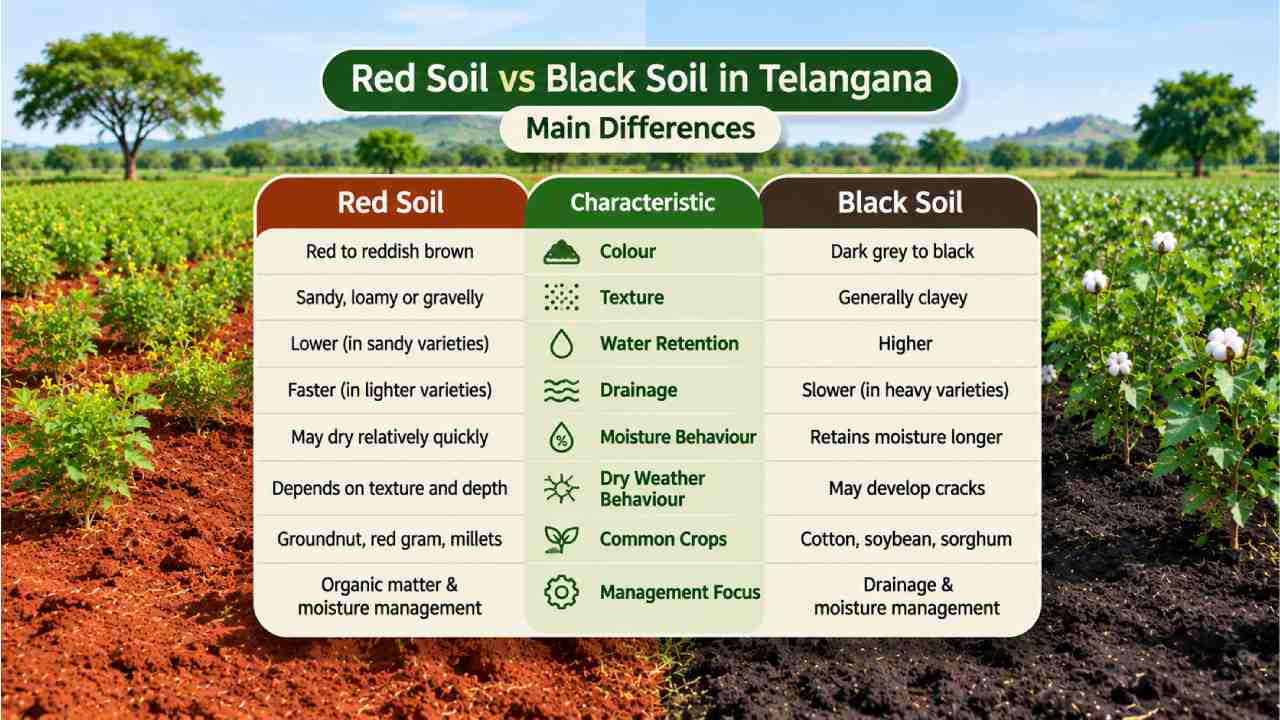
3. Red Soil vs Black Soil in Telangana: Main Differences
The following table explains the general differences between these two soil types.
| Characteristic | Red Soil | Black Soil |
|---|---|---|
| Colour | Red to reddish brown | Dark grey to black |
| Texture | Sandy, loamy or gravelly | Generally clayey |
| Water retention | Often lower in sandy varieties | Generally higher |
| Drainage | Often faster in lighter varieties | Can be slower in heavy varieties |
| Moisture behaviour | May dry relatively quickly | Retains moisture longer |
| Dry weather behaviour | Depends on texture and depth | May develop cracks |
| Common crop associations | Groundnut, red gram, millets | Cotton, soybean, sorghum |
| Management focus | Organic matter and moisture management | Drainage and moisture management |
Important: These are general characteristics, not fixed rules. Two agricultural plots in the same village can have different soil depths, textures and fertility levels.
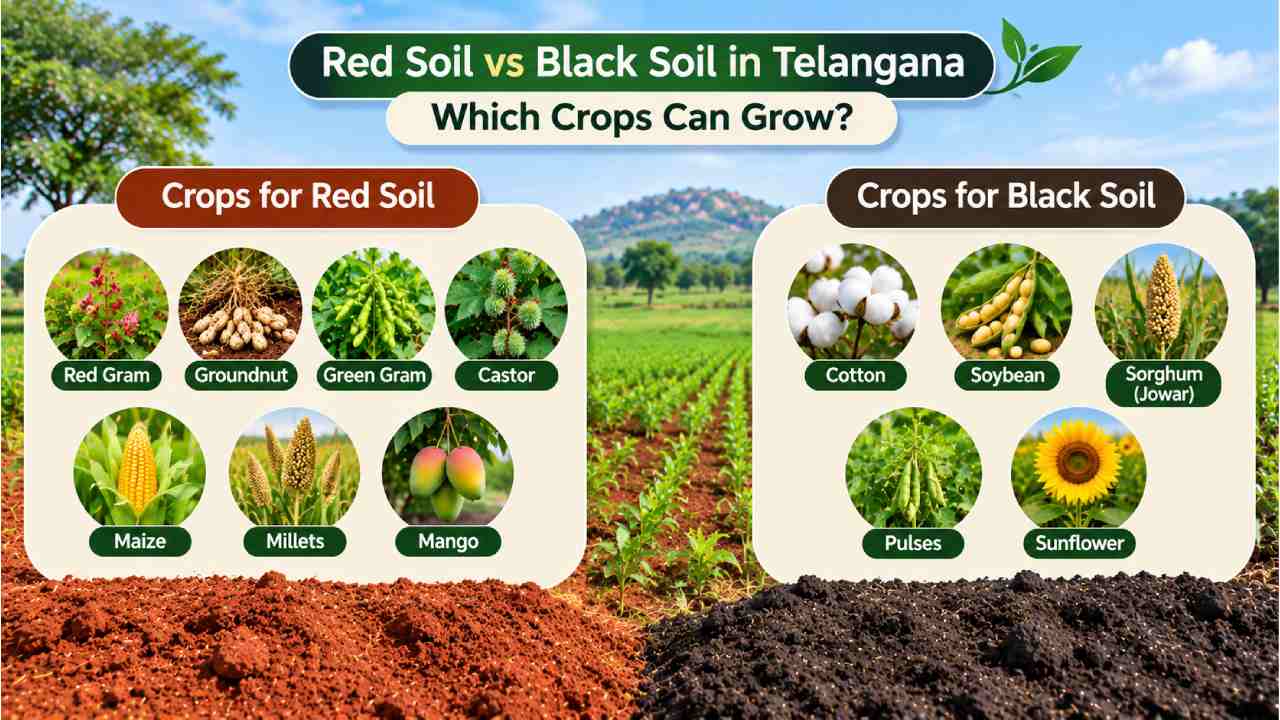
4. Red Soil vs Black Soil in Telangana: Which Crops Can Grow?
Crop selection should be based on actual soil conditions rather than soil colour alone.
Crops for suitable red soils
| Crop | Important consideration |
|---|---|
| Red gram | Suitable variety and seasonal moisture |
| Groundnut | Well-drained soil and suitable moisture |
| Green gram | Seasonal rainfall and moisture |
| Castor | Variety selection and crop management |
| Maize | Adequate water and nutrient management |
| Millets | Local rainfall and suitable varieties |
| Mango | Soil depth, drainage and irrigation |
Red sandy soils may need additional moisture management, particularly during dry periods.
Crops for suitable black soils
| Crop | Important consideration |
|---|---|
| Cotton | Soil depth and drainage |
| Soybean | Suitable moisture and field drainage |
| Sorghum (Jowar) | Seasonal conditions and variety |
| Pulses | Crop-specific drainage and nutrient needs |
| Sunflower | Soil condition and moisture management |
Heavy black soils may require careful field preparation and drainage management to avoid excessive water stagnation.
No crop should be considered guaranteed to perform well simply because a plot has a particular soil colour.
5. Red Soil vs Black Soil in Telangana: Regional Soil Distribution
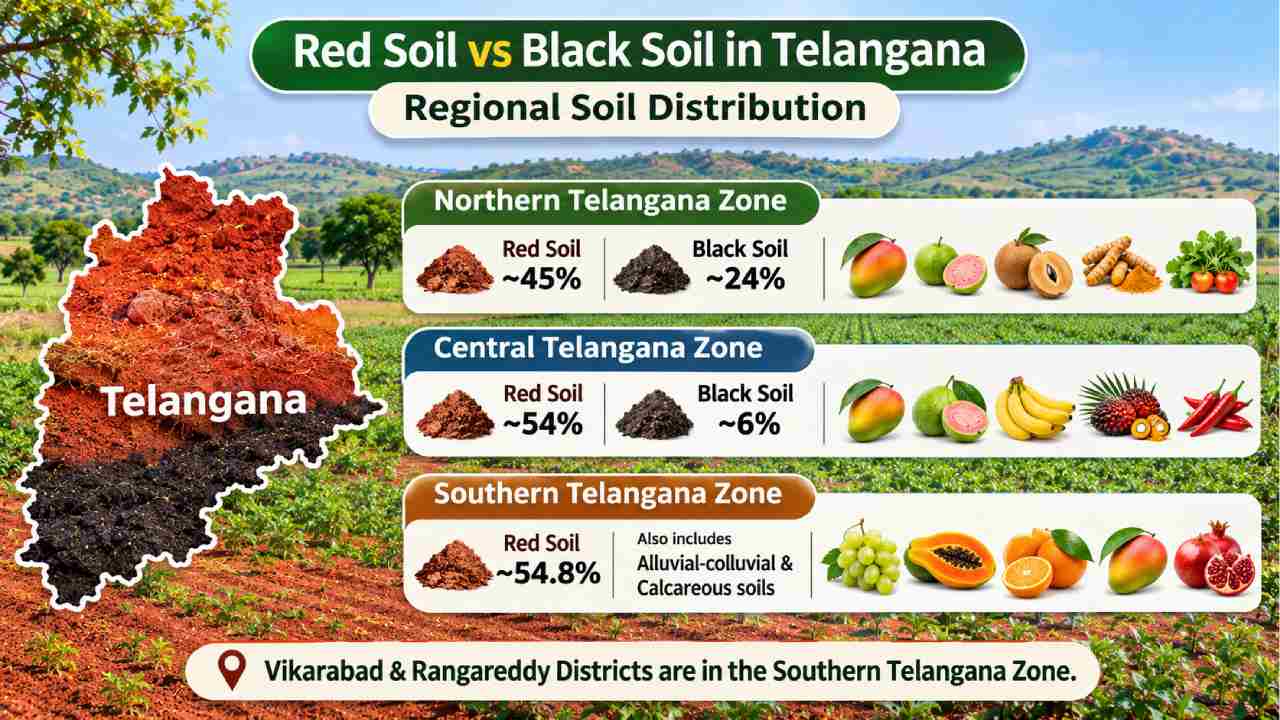
Telangana is divided into three major agro-climatic zones: Northern Telangana, Central Telangana and Southern Telangana.
According to the Sri Konda Laxman Telangana Horticultural University, the soil distribution differs across these zones.
Northern Telangana Zone
- Red soils of different textures account for approximately 45% of the zone.
- Black soils account for approximately 24%.
- Other major soil groups include calcareous soils.
- The university lists crops such as mango, guava, sapota, turmeric and vegetables among the predominant crops.
Central Telangana Zone
- Red soils account for approximately 54% of the zone.
- Calcareous soils account for approximately 13%.
- Black soils account for approximately 6%.
- Predominant crops include mango, guava, banana, oil palm, vegetables and chillies.
Southern Telangana Zone
- Different textured red soils account for approximately 54.8% of the zone.
- Alluvial-colluvial soils and calcareous soils are also present.
- The university lists grapes, papaya, sweet orange, mango, pomegranate, vegetables and other horticultural crops among the predominant crops.
Vikarabad and Rangareddy districts are included in the Southern Telangana Zone.
This regional information is useful for understanding broad agricultural conditions. However, it does not establish the soil type of an individual agricultural plot. A field-level assessment is still necessary.
6. How Soil Testing Helps Identify Land Quality
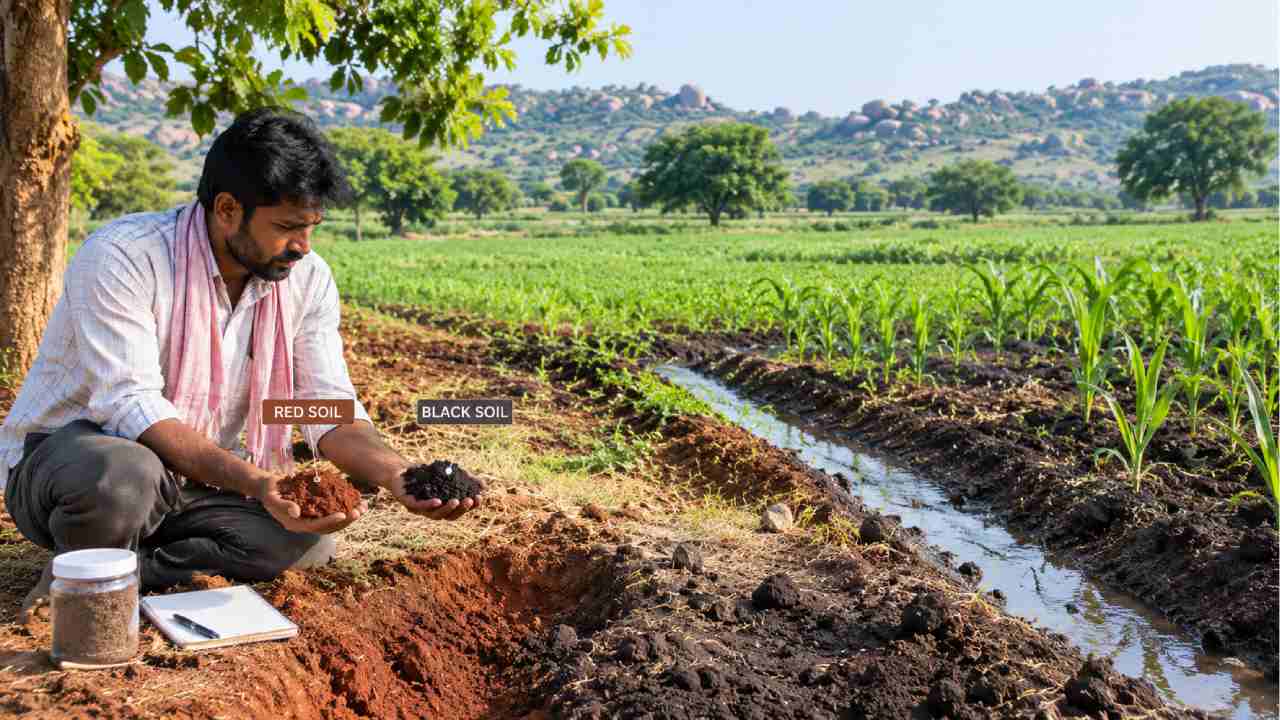
Visual inspection can provide an initial idea about soil colour and texture, but it cannot accurately establish the complete fertility status of agricultural land.
A soil test provides scientific information about the soil’s chemical and nutrient characteristics.
Farmers can also refer to the Government of India’s Soil Health Card Scheme to understand soil testing and nutrient management recommendations.
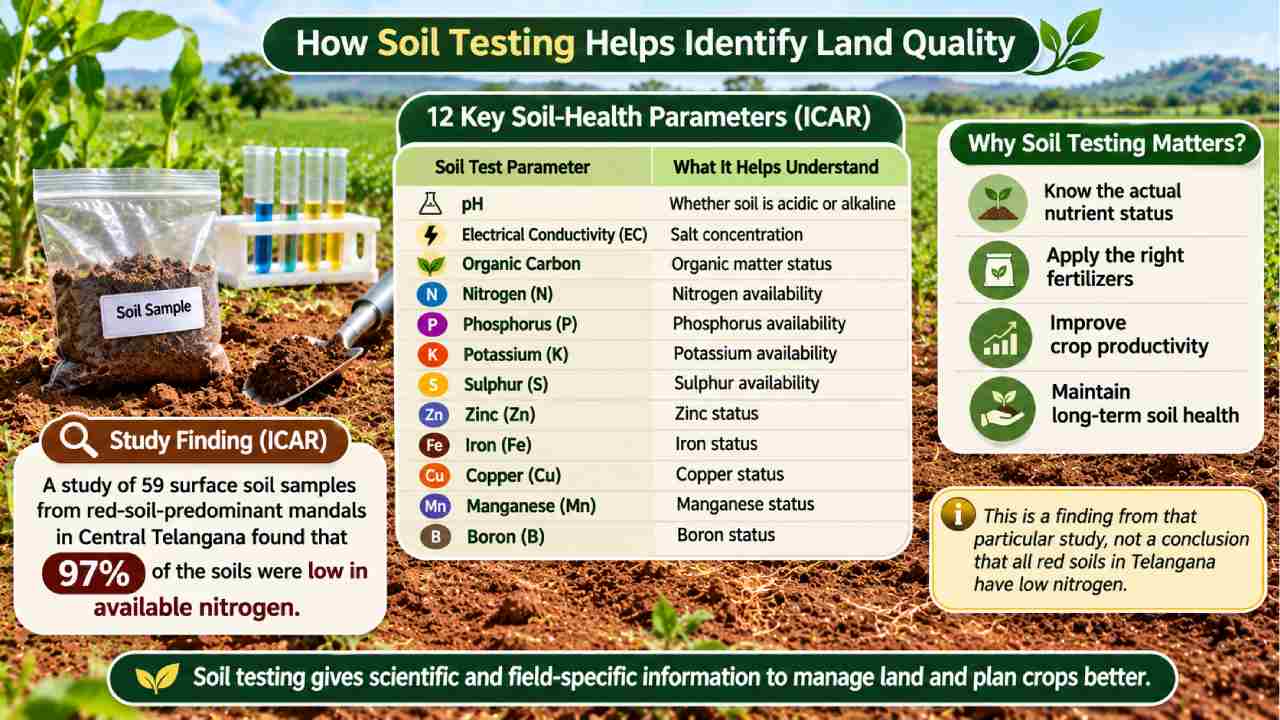
According to the Government of India’s Ministry of Agriculture and Farmers Welfare, ICAR recommends 12 important soil-health parameters:
| Soil test parameter | What it helps understand |
|---|---|
| pH | Whether soil is acidic or alkaline |
| Electrical Conductivity (EC) | Salt concentration |
| Organic Carbon | Organic matter status |
| Nitrogen (N) | Nitrogen availability |
| Phosphorus (P) | Phosphorus availability |
| Potassium (K) | Potassium availability |
| Sulphur (S) | Sulphur availability |
| Zinc (Zn) | Zinc status |
| Iron (Fe) | Iron status |
| Copper (Cu) | Copper status |
| Manganese (Mn) | Manganese status |
| Boron (B) | Boron status |
Why is this important?
An ICAR-published study of 59 surface soil samples from red-soil-predominant mandals in Central Telangana found that 97% of the sampled soils were low in available nitrogen.
This is a finding from that particular study, not a conclusion that all red soils in Telangana have low nitrogen.
Soil testing helps farmers understand the actual nutrient requirements of their land rather than applying fertilizers based on assumptions.
7. What Should Agricultural Land Buyers Check Before Buying?
Understanding Red Soil vs Black Soil in Telangana is a useful starting point, but buyers should evaluate the actual land before making a purchase decision.
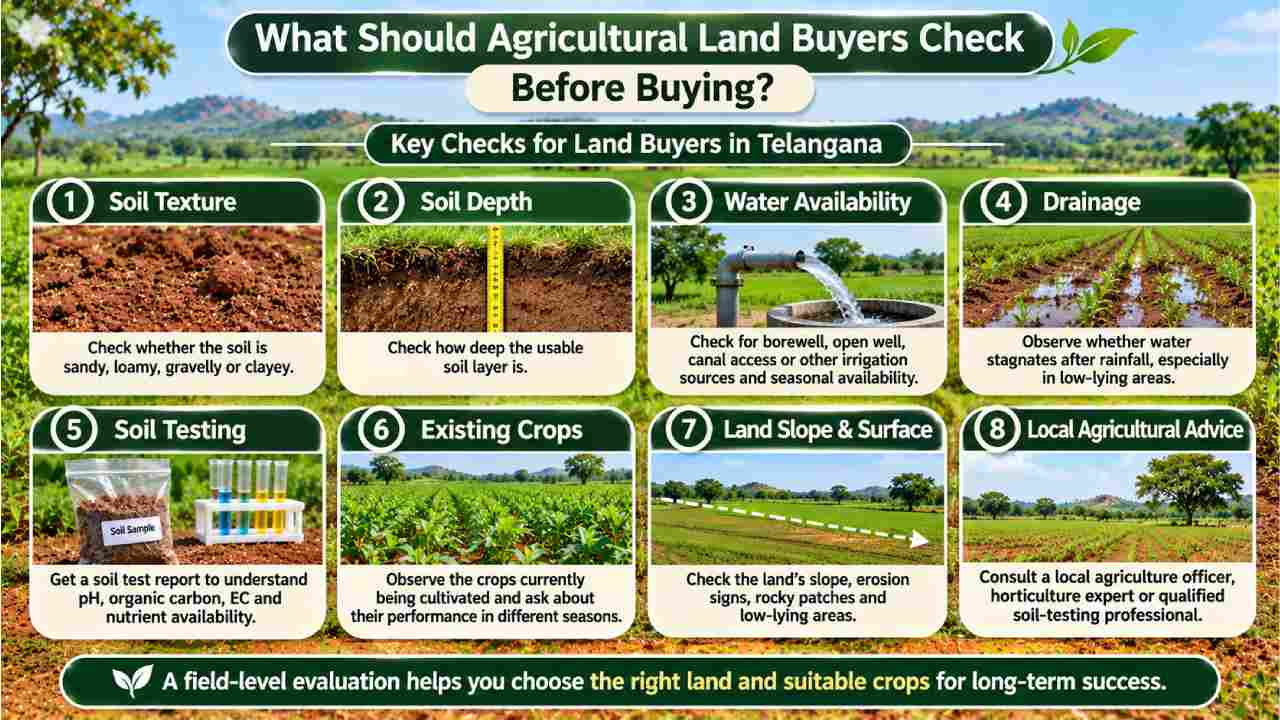
Here are eight practical checks:
1. Soil Texture
Check whether the soil is sandy, loamy, gravelly or clayey.
2. Soil Depth
Check how deep the usable soil layer is. Shallow and deep soils can have different crop suitability.
3. Water Availability
Understand whether the property has a borewell, open well, canal access or another irrigation source. Also check seasonal water availability.
4. Drainage
Observe whether water stagnates after rainfall, especially in low-lying portions of the property.
5. Soil Testing
Obtain a soil test report to understand pH, organic carbon, EC and nutrient availability.
6. Existing Crops
Observe the crops currently being cultivated and ask about their performance during different seasons.
7. Land Slope and Surface Conditions
Check the land’s slope, erosion signs, rocky patches and low-lying areas.
8. Local Agricultural Advice
Consult a local agriculture officer, horticulture expert or qualified soil-testing professional before deciding which crops to cultivate.
8. How to Improve Soil Conditions for Better Agriculture
Both red and black soils can benefit from suitable soil-management practices.
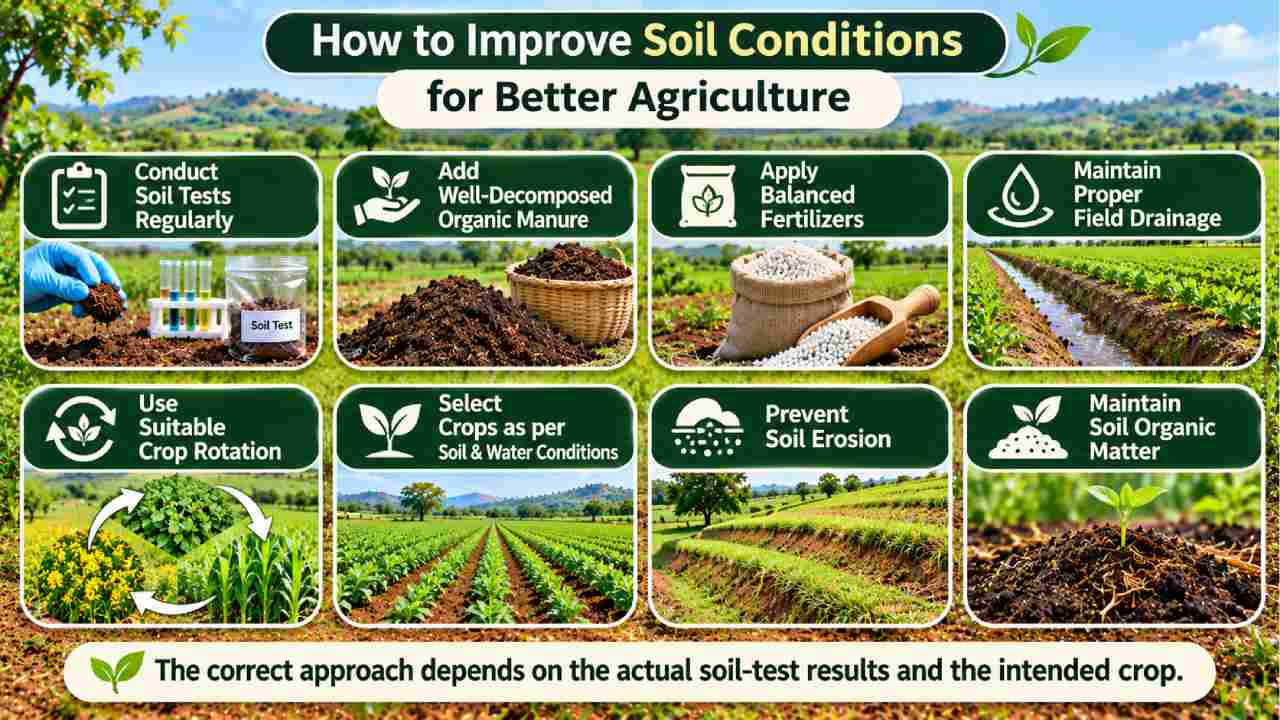
Some useful practices include:
- Conducting soil tests at appropriate intervals.
- Adding well-decomposed organic manure based on soil-test recommendations.
- Applying balanced fertilizers according to crop requirements.
- Maintaining proper field drainage.
- Using suitable crop rotation practices.
- Selecting crops according to soil and water conditions.
- Preventing soil erosion.
- Maintaining soil organic matter.
The correct approach depends on the actual soil-test results and the intended crop.
9. Which Is Better: Red Soil or Black Soil?
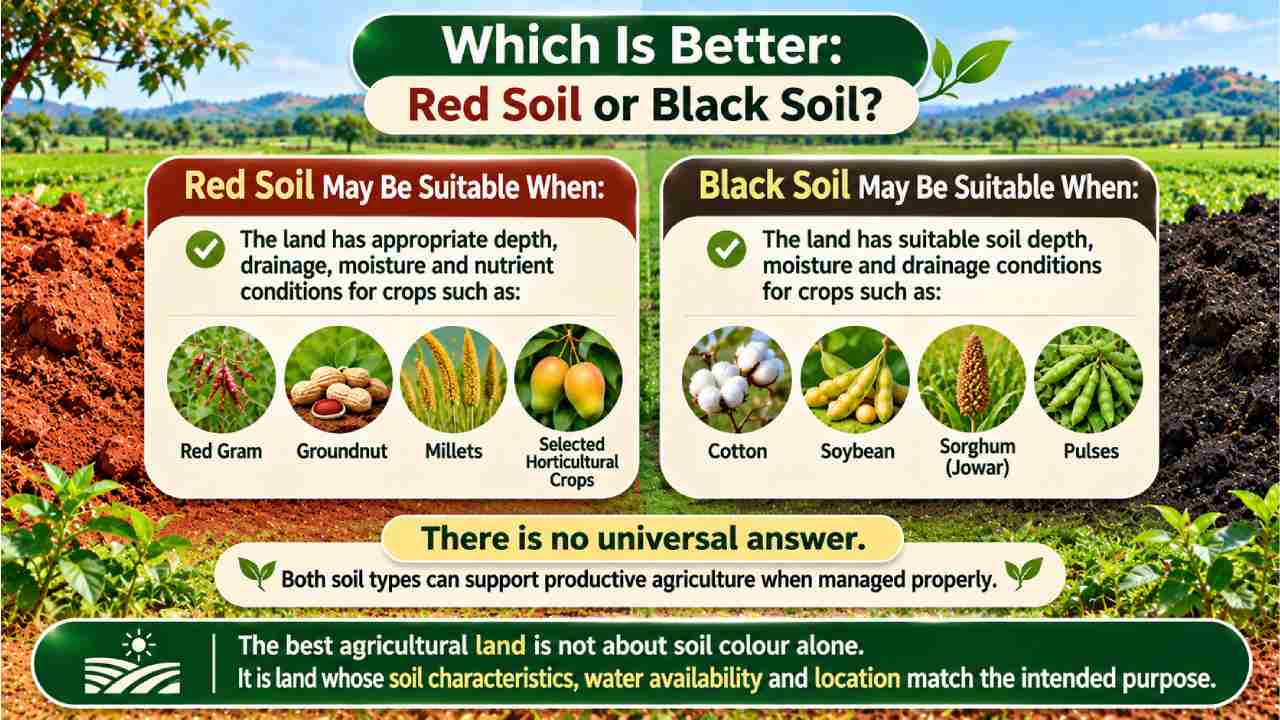
There is no universal answer. Both soil types can support productive agriculture when managed properly.
Red soil may be suitable when: The land has appropriate depth, drainage, moisture and nutrient conditions for crops such as red gram, groundnut, millets and selected horticultural crops.
Black soil may be suitable when: The land has suitable soil depth, moisture and drainage conditions for crops such as cotton, soybean, sorghum and pulses.
The best agricultural land is not necessarily the land with the most attractive soil colour. It is land whose soil characteristics, water availability and location match the intended agricultural purpose.
Conclusion
Red soil and black soil both play an important role in Telangana agriculture. Red soils support a range of crops, including pulses, groundnut, millets and selected horticultural crops. Black soils are commonly associated with cotton, soybean, sorghum and pulses.
However, successful cultivation depends on more than soil colour. Soil depth, water availability, drainage, nutrients, climate and suitable crop selection are equally important.
For anyone planning to purchase agricultural land in Telangana, understanding Red Soil vs Black Soil in Telangana can help with the initial evaluation. A proper soil test and local agricultural advice should be part of the decision-making process.
At Bhoomi Infrastructure, we believe that understanding the land is an important step towards making an informed agricultural land purchase decision.
Sources and References
- Government of Telangana – Telangana State Statistical Abstract, 2021, Agriculture chapter.
- Sri Konda Laxman Telangana Horticultural University – Agro-Climatic Zones of Telangana.
- ICAR / PJTSAU Journal of Research – Soil Fertility Status of Paddy Growing Red Soils of Central Telangana Zone Districts of Telangana State, India (2023).
- Press Information Bureau, Ministry of Agriculture and Farmers Welfare – Testing of Soil Quality (14 December 2021).
Disclaimer: This article is for general educational purposes. Soil conditions and crop suitability vary from plot to plot. Consult qualified agricultural experts and obtain a soil test before making cultivation decisions.