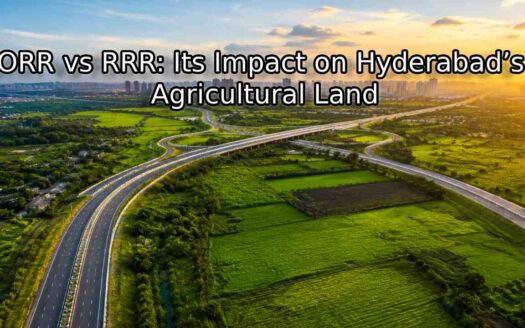
AI and the Future of Money: GPT-6 Astra and Jobs
AI and the future of money– AI Is Changing Faster Than We Think
AI and the future of money are changing faster than most people realise—and the way we earn, save, and build wealth may change with them. Technology has always changed the way people work.
But today, the speed of change feels different.
Artificial intelligence is no longer limited to answering simple questions or generating a few lines of text.
New AI systems are becoming capable of handling research, coding, computer tasks, professional work and complex multi-step activities.
One of the latest examples is GPT-6 Astra, OpenAI’s newest AI model. OpenAI describes Astra as its most capable model yet, with major improvements in computer use, browsing, software engineering, science, cybersecurity and professional work.
But what could this mean for everyday families?
What if AI is able to do more jobs? What could happen to the future of jobs and income?
The answer is not that everyone will lose their job. Instead, AI may change the way people work, earn and build financial security.
The future may belong to people who do two things at the same time: keep improving their skills and build financial security outside their monthly income.
That is where saving, investing and building long-term assets become important.
To summarise, AI and the future of money are intertwined because changes in technology can affect jobs, income, saving and how people plan for long-term financial security.
“That is where saving, investing and building long-term assets become important.”
This is where AI and the future of money become closely connected, because changes in technology can also change the way people earn, save and build financial security.

What is Astra gpT-6?
OpenAI has developed a new generation of artificial intelligence called GPT-6 Astra.
Unlike older AI systems that were mainly used for conversations, writing or answering questions, Astra is designed to handle much more complex tasks.
According to OpenAI, Astra can work with computers and browsers, perform software engineering, conduct research, create documents and spreadsheets, analyse information and support professional workflows.
In simple words, AI is moving from:
“Tell me how to do something.”
towards:
“Help me actually do it.”
That is a major change.
For businesses that could mean faster work and more productivity.
For workers, that could mean some routine tasks are automated, while other jobs change.
And for families, it means one thing is getting increasingly important:
Getting ready for a future that may not be the same as today.

Why is GPT-6 Astra significant?
GPT-6 Astra is important because it shows how fast AI capabilities are advancing.
OpenAI says Astra has made significant advances in computer use and professional work. Its model documentation describes it as being built for difficult end-to-end work involving reasoning, coding, computer use, research and document creation.
Understanding AI and the future of money is not only about understanding technology. It is also about understanding how changing technology may influence jobs, income and long-term financial planning.
This does not mean that AI will suddenly replace every worker.
It means the nature of work is changing.
If you know how to use AI, you might be able to do things faster than someone who doesn’t have that skill.
A business that uses AI well could possibly operate differently from a business that doesn’t.
So the crucial question is not:
Will AI replace humans?
A better question might be:
“What will the future of humans and AI working together look like?”
How Might AI Transform Jobs?
Here is where the discussion gets serious.
The World Economic Forum’s Future of Jobs Report 2025 predicts significant shifts in the global labour market by 2030.
Its employer survey projects around 170 million new jobs and 92 million displaced jobs, resulting in a net increase of about 78 million jobs.
So the picture is not simply “AI destroys all jobs.”
Some jobs may decline.
New jobs may appear.
Many existing jobs may change.
And workers may need new skills.
The same report says employers expect AI and information-processing technologies to be among the biggest forces transforming businesses by 2030. It also highlights the growing importance of AI, big data, cybersecurity and technological literacy, alongside human skills such as creative thinking, resilience and collaboration.
That gives us a very important lesson:
Your job may change, even if your profession does not disappear.
Does AI Mean Everyone Will Lose Their Jobs?
No.
It’s not true that GPT-6 Astra or any other AI model will make everyone unemployed.
Technology can eliminate some tasks and create new tasks and opportunities.
For example, artificial intelligence can decrease the time a person spends on repetitive tasks, but increase the importance of decision-making, communication, creativity, technical knowledge and human relationships.
The World Economic Forum expects both job creation and job displacement as technology and other economic forces reshape work.
The real concern is not necessarily unemployment for everyone.
The bigger concern is change.
A person who depends completely on one job, one income source or one skill may have less financial flexibility if their work changes.
That is why future planning matters.
Why Could Income Become Less Predictable?
Imagine a family where the entire monthly financial plan depends on one salary.
The salary pays for:
- Home expenses
- Children’s education
- Loans
- Medical and emergency costs
- Family needs
- Savings
- Future plans
Everything depends on that one income.
Now imagine the person’s industry changes.
Their company adopts new technology.
Their role changes.
Their salary growth slows down.
Or they need to learn a completely new skill.
The family may suddenly feel financial pressure.
This does not mean such a situation will definitely happen.
But it explains why financial resilience is important.
The International Monetary Fund notes that AI is already reshaping labour markets and that its effects can differ across workers depending on how AI complements or substitutes for different types of work.
So instead of fearing AI, families can use this period as a reminder:
Don’t depend only on today’s income. Build a stronger financial foundation for tomorrow. As AI continues to influence work and businesses, AI and the future of money are becoming increasingly connected. The way people earn money may change, which makes saving, investing and building long-term assets important parts of financial preparation.
Saving Money vs Building Long-Term Assets
Saving money is important.
Everyone should try to save money for emergencies and for future needs.
But there is a difference between saving and building assets.
For people comparing different forms of property ownership, understanding the differences between agricultural land and residential plots can also be useful before making a long-term decision.
When income patterns can change, saving, investing and building long-term assets can all play different roles in a family’s financial plan.
Money in reserve can provide financial security and liquidity.
Assets can be incorporated into a longer term financial architecture.
That doesn’t mean you don’t need savings.
Actually savings and investments have different objectives.
One practical approach might be:
Emergency savings → Insurance and protection → Skills development → Diversified investments → Long-term assets
The right mix will vary based on a person’s income, age, obligations, risk tolerance and financial objectives.
The concept is simple:
Don’t put all your rupees in one basket, and don’t depend on just one source of financial security.
Diversification is one of the most common investment principles . Diversification involves spreading your money across different investments so you don’t have too much riding on one asset. Thinking about AI and the future of money also means thinking beyond today’s salary and considering how different forms of savings, investments and assets can fit into a long-term financial plan.

Why Physical Assets Can Matter in an Uncertain Future
Technology can change very quickly.
Software can become outdated.
A business model can change.
A job role can disappear or transform.
But some physical assets have a different nature.
In discussions about AI and the future of money, physical assets such as land can also become part of the conversation because they represent a different type of long-term holding from digital or financial assets.
One example is land.
Land is a real asset. You can see it physically, confirm its boundaries and use it for different purposes depending on location, zoning, permissions and applicable laws.
It has potential for agriculture, a farmhouse, future development or other permitted use.
But there’s an important point here:
Land is not automatically a good investment because it is land.
Location, title, access, zoning, water availability, development potential and purchase price all matter.
That is why land investment should be approached carefully. This is an important part of understanding AI and the future of money. When income patterns can change, simply earning and saving may not be enough for every family’s long-term financial goals.

Why Land Is Worth Thinking About as a Long-Term Asset
For many families, land represents something very different from a digital investment.
You can visit it.
You can see the surrounding development.
You can check the road.
You can understand the neighbourhood.
You can examine the physical property.
But land also has its limitations.
It may not sell fast.
It can be worth wildly different amounts from one place to another.
Its value and usefulness may be affected by legal problems.
Development plans can change.
And paying an unreasonable price can damage the potential for future returns.
So the correct message is not:
“Buy land and you will become rich.”
The better message is:
“If land fits your financial plan, study it carefully and consider it as one part of a diversified long-term asset strategy.”
For people considering agricultural land near Hyderabad, factors such as location, road connectivity, surrounding development and legal verification should be studied carefully.
But Not Every Piece of Land Is a Good Investment
This is one of the most important points in the entire article.
Two pieces of agricultural land can be located only a few kilometres apart and still have completely different investment potential.
For example, people researching agricultural land in Parigi should evaluate connectivity, surrounding development, title and the specific property rather than judging the entire area only by its name.
Why?
Because location is more than a pin on Google Maps.
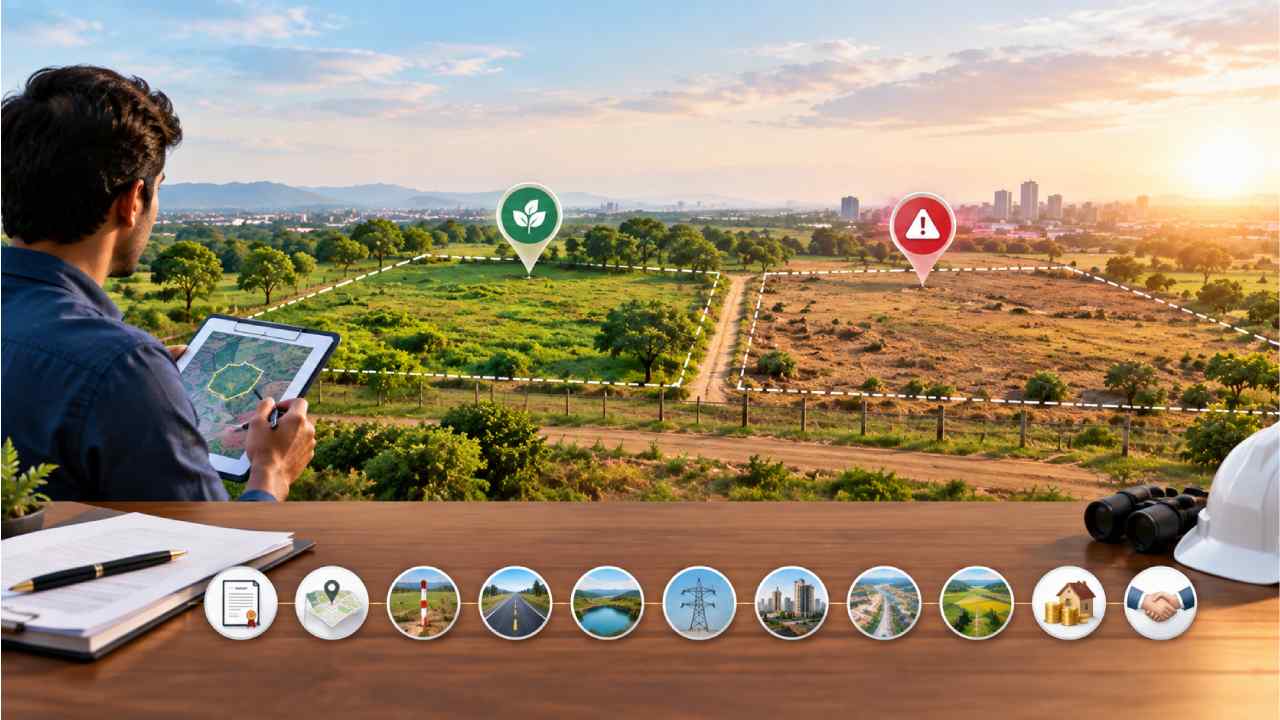
When you buy land, consider:
Legal owner
Title history
Survey Information
Access via road
Land limitations
Where applicable, the Government approvals
Water availability –
Nearby development
Infrastructure in place
Future infrastructures
Land use in the surrounding area
Purchase price
Exit strategies.
A decision to buy land should be based on facts about the property, not on assumptions about what might be built there in the future.
In plain words:
Never buy land just because someone says the area will be the next big place.
only because someone says the area will become the next big location.
Verify it yourself.
Why Location and Infrastructure Matter
As Hyderabad continues to expand, people increasingly look beyond established city areas.
One example is agricultural lands in Pargi, where buyers may compare road connectivity, distance from Hyderabad and surrounding development before evaluating a property. Chevella is another location that buyers researching agricultural land near Hyderabad may compare based on connectivity, surrounding development and the type of property available.
But the important question is not simply:
“Is this land outside Hyderabad?”
Ask:
“What is happening around this land?”
Look at roads.
Look at employment centres.
Look at nearby towns.
Look at schools and hospitals.
Look at industrial and commercial activity.
Look at government infrastructure plans.
Look at how easily people can reach the location.
This is why infrastructure can influence real-estate interest.
Official Planning Information for Hyderabad and surrounding areas is especially important. HMDA publishes master planning information which includes Master Plan 2031 documents and planning information for areas like Chevella. HMDA says Hyderabad Metropolitan Region has been extended till Regional Ring Road with a buffer area. So official planning documents are important when one is researching development around the metropolitan region.
Upcoming infrastructure, improved connectivity and surrounding development can contribute to interest in land and property, but development does not automatically guarantee appreciation.
The Telangana Government has also issued an order concerning the incorporation of the proposed RRR alignment as a Master Plan Road within the Hyderabad Metropolitan Region.
Understanding development can help a buyer make a more informed decision.

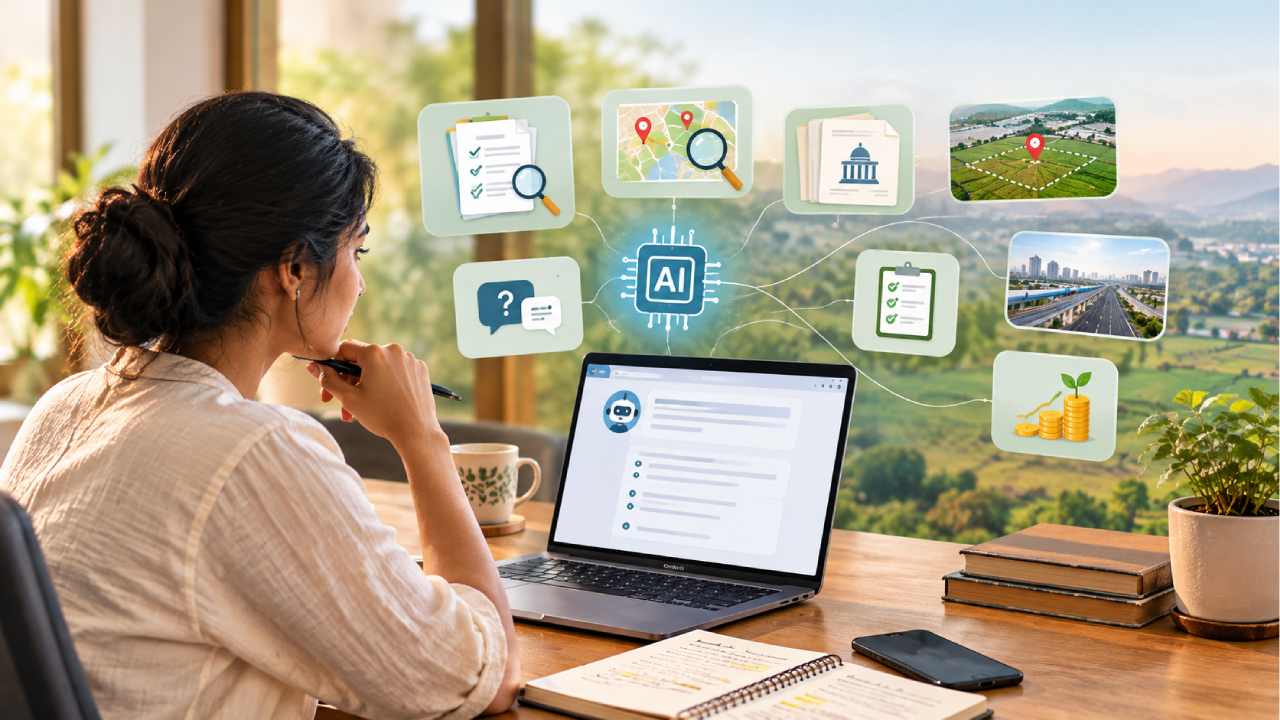
How AI Can Help People Research Property
Interestingly, the same technology that is changing jobs can also help people make better property decisions.
As we think about AI and the future of money, the same technology changing the workplace can also help people become more informed about major financial decisions such as property purchases.
AI can help you:
- Understand real-estate terminology
- Compare locations
- Create property-checking questions
- Summarise government documents
- Organise property information
- Identify questions you should ask a developer
- Compare infrastructure proposals
- Understand basic land-investment concepts
- Prepare a due-diligence checklist
For example, instead of asking:
“Is this land good?”
you can ask AI:
“What documents should I verify before buying agricultural land in Telangana?”
Or:
“What questions should I ask before buying agricultural land near Hyderabad?”
That gives you a much better starting point.
Why You Should Never Trust AI Alone When Buying Land
This is extremely important.
AI can help you research.
AI should not replace legal verification.
An AI system may misunderstand a document, use outdated information or miss a property-specific issue.
Before purchasing land, important matters should be verified through appropriate official records and qualified professionals.
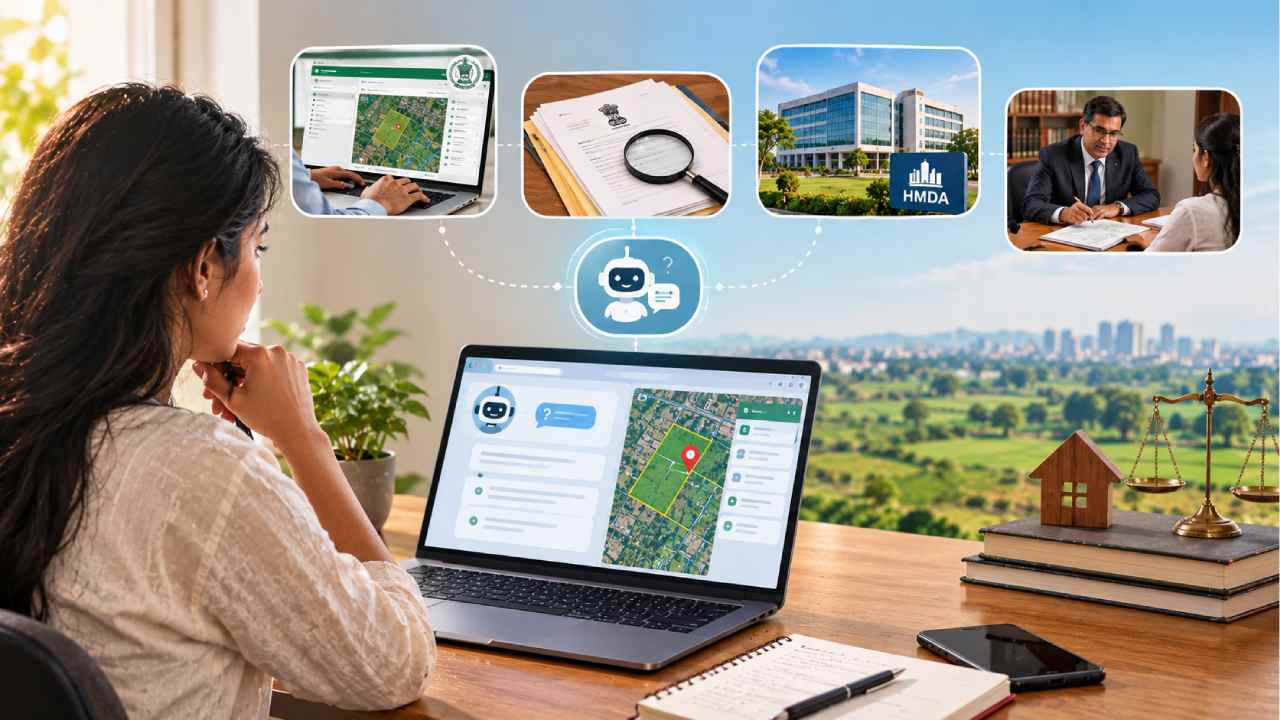
For Telangana agricultural land, government sources can provide useful starting points for this verification. The Telangana Bhu Bharati system provides land-record and parcel information, including search facilities for land details and registered document details. Its GIS service also provides parcel information based on selected district, mandal and village details.
For development and planning questions around Hyderabad, buyers can also refer to official HMDA planning resources rather than relying only on social-media claims or property advertisements.
Use AI to create questions.
Use official records to verify facts.
Use qualified legal and property professionals when necessary.
Think of AI as a research assistant, not the final authority.
That approach becomes even more important as AI systems become more powerful.
How Should Families Prepare for an AI-Driven Future?
Nobody knows exactly what the job market will look like ten or twenty years from now.
So instead of trying to predict everything, prepare for uncertainty.
A family can focus on a few basic principles.
1. Keep an emergency fund
Unexpected expenses can happen at any time.
2. Keep improving your skills
AI is changing the value of different skills. Learning should not stop after college.
3. Avoid unnecessary debt
Large financial commitments can become difficult if income changes.
4. Protect the family
Insurance and appropriate financial protection can reduce the impact of unexpected events.
5. Build diversified investments
Don’t depend entirely on one asset or one income source.
6. Think about long-term assets
Depending on your financial situation, assets such as land or other investments may form part of a long-term plan.
7. Teach children about money
Children should understand saving, spending, investing and financial responsibility.
The goal is not to predict the future perfectly.
The goal is to be prepared when the future changes.
A Simple Future Financial Plan
You don’t need a complicated formula.
Think of your financial life as several layers:
Income
Earn through your job, business or profession.
Savings
Keep money available for emergencies and short-term needs.
Protection
Use appropriate insurance and risk protection.
Skills
Keep learning so your earning ability can adapt.
Investments
Build a diversified investment portfolio according to your goals and risk level.
Long-term assets
Consider suitable physical or financial assets for long-term wealth building.
This is not a promise of returns.
It is simply a way of thinking about financial resilience.
Why Land Could Be Part of This Conversation
This is one reason AI and the future of money should be viewed from a broader perspective. The conversation is not only about artificial intelligence replacing or changing work; it is also about how individuals can prepare their finances for a changing economy. When people hear the word “AI,” they usually think about technology.
But AI may eventually change the way people think about money too.
If technology changes jobs, people may start thinking more seriously about:
“How can I protect my family’s financial future?”
One possible answer is not to depend on only one thing.
Not one job.
Not one business.
Not one investment.
Not one asset.
Land can be one component of a long-term financial plan for people who understand its risks, can afford the investment and choose property carefully.
This is one reason AI and the future of money should be viewed from a broader perspective. The conversation is not only about artificial intelligence changing work; it is also about how individuals can prepare their finances for a changing economy.
For a family looking at agricultural land near Hyderabad, the decision should be based on actual location fundamentals rather than simply on the excitement surrounding AI or future development.
AI can help you research the opportunity.
Your financial plan should decide whether you can afford it.
Proper verification should decide whether the property is worth considering.
What Should a Telangana Land Buyer Verify?
For readers specifically considering agricultural land in Telangana, the research process should go beyond asking about price and future appreciation. Buyers can also compare locations such as agricultural lands in Kondurg by looking at access, surrounding development, property documents and actual site conditions.
A practical starting checklist is:
- Check the survey number and land details through relevant government records.
- Check available Record of Rights and parcel information.
- If applicable check registered document information.
- Verify the physical property boundaries in the field.
- Confirm ownership and title through proper legal due diligence.
- Check road access, don’t just look at the map location.
- Be aware of any land-use restrictions and permissions that apply.
- Check that any planning information the proposed development is using to support its claims is official.
- Compare the property with surrounding development and infrastructure.
- Take professional legal advice before completing a major purchase.
The Telangana Bhu Bharati system provides online land-record and registered-document services that can be used as part of the initial research process.
This is an important distinction:
AI can help you understand what to check. Government records and professional verification help you establish what is actually recorded.
A Practical AI + Real Estate Research Approach
The future of property research does not have to be AI versus traditional verification.
It can be:
AI for research
↓
Official government sources for verification
↓
Physical site inspection
↓
Legal due diligence
↓
Financial evaluation
↓
Investment decision
This approach can be useful for people researching agricultural land around Hyderabad and other parts of Telangana.
It also illustrates a broader lesson about AI and the future of money:
Technology can improve the way we research decisions, but major financial decisions still require human judgement and verification.
What You Should Know Before Buying Land
Don’t jump into buying agricultural land or any other property.
Verify:
Title and ownership documents
Limits and survey number
Liens and encumbrances
Land use classification
Road access.
Water supply.
Government restrictions
Layout or development approvals, if applicable
local infrastructure
Plans for future development
Current market prices in the surrounding area
Reputation of seller or developer
Legal due diligence
Buyers can also review the government’s property purchase precautions before proceeding with a land transaction.
Don’t base a big property decision on the location trending on social media.
A good investment decision starts with facts.
Conclusion – Prepare for the Future, Don’t Fear It
GPT-6 Astra is another sign of how quickly artificial intelligence is advancing.
AI can write, research, code, use computers and handle increasingly complex professional tasks.
But the future is not simply about machines becoming smarter.
It is also about how people respond.
A person who keeps learning can prepare for changing work.
A family that saves wisely can build greater financial flexibility.
A person who builds a diversified financial foundation can prepare for uncertainty.
And someone considering land or another long-term asset can take the time to research, verify and choose carefully.
The goal is not to predict exactly what GPT-6 Astra or future AI systems will do.
The goal is to make sure your family is prepared even when the future does not go exactly as expected.
AI and the future of money will continue to evolve as artificial intelligence becomes more capable and the world of work changes. The important response is not to predict every change, but to build financial habits and assets that can help families remain prepared for different possibilities.
Technology may change quickly.
Jobs may change.
Income patterns may change.
But the basic idea of preparing for tomorrow will never go out of date.
Learn. Save. Build. Verify. Prepare.
That may be one of the most practical ways to face the AI-powered future.