Remote Land Management: Managing Agricultural Land from Hyderabad
Remote Land Management: A practical guide for agricultural landowners on local supervision, property maintenance, water monitoring and regular inspections.
Owning agricultural land is one thing. Managing it when you live far away is another challenge.
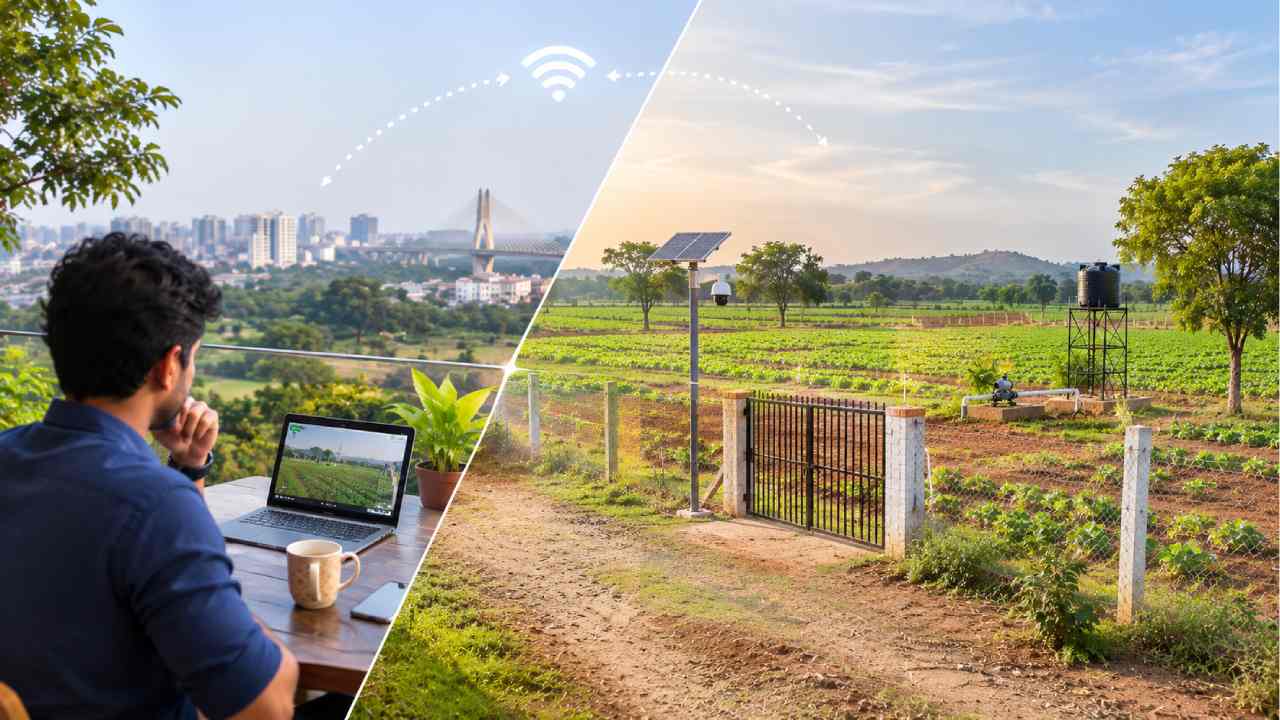
Many people living in Hyderabad own or plan to purchase agricultural land in places such as Pargi, Chevella, Moinabad and other nearby areas. But visiting the property regularly may not always be possible because of work, family responsibilities or travel time.
This is where Remote Land Management becomes important.
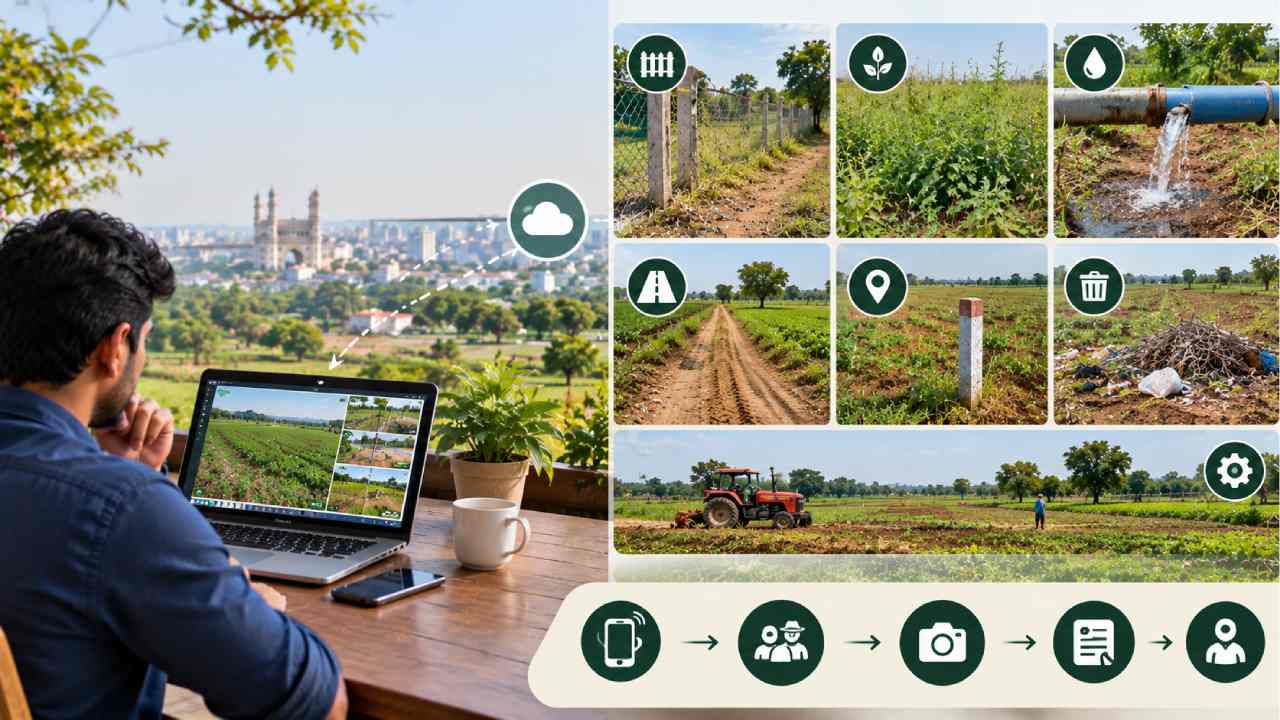
With proper planning, reliable local support and regular monitoring, landowners can keep track of their property without travelling to the site every week. However, remote monitoring should support physical inspections, not replace them.
In this guide, we explain practical ways to manage agricultural land when you cannot visit it regularly.
1. Remote Land Management: Why Is It Important?
Agricultural land needs regular attention, even when no crops are being cultivated.
Without proper supervision, small problems can become bigger over time. For example:
- Fencing may get damaged.
- Unwanted vegetation may grow.
- Water pipes or irrigation equipment may develop leaks.
- Access paths may become difficult to use.
- Boundary markers may get disturbed.
- Waste or debris may accumulate.
- Maintenance work may be delayed.
For people living in Hyderabad and owning land in another location, Remote Land Management helps create a simple system to monitor these activities.
The aim is not to manage every activity from a mobile phone. It is to make sure that someone responsible is available locally and that the landowner receives regular, reliable updates.
2. Remote Land Management: Choose a Reliable Local Caretaker
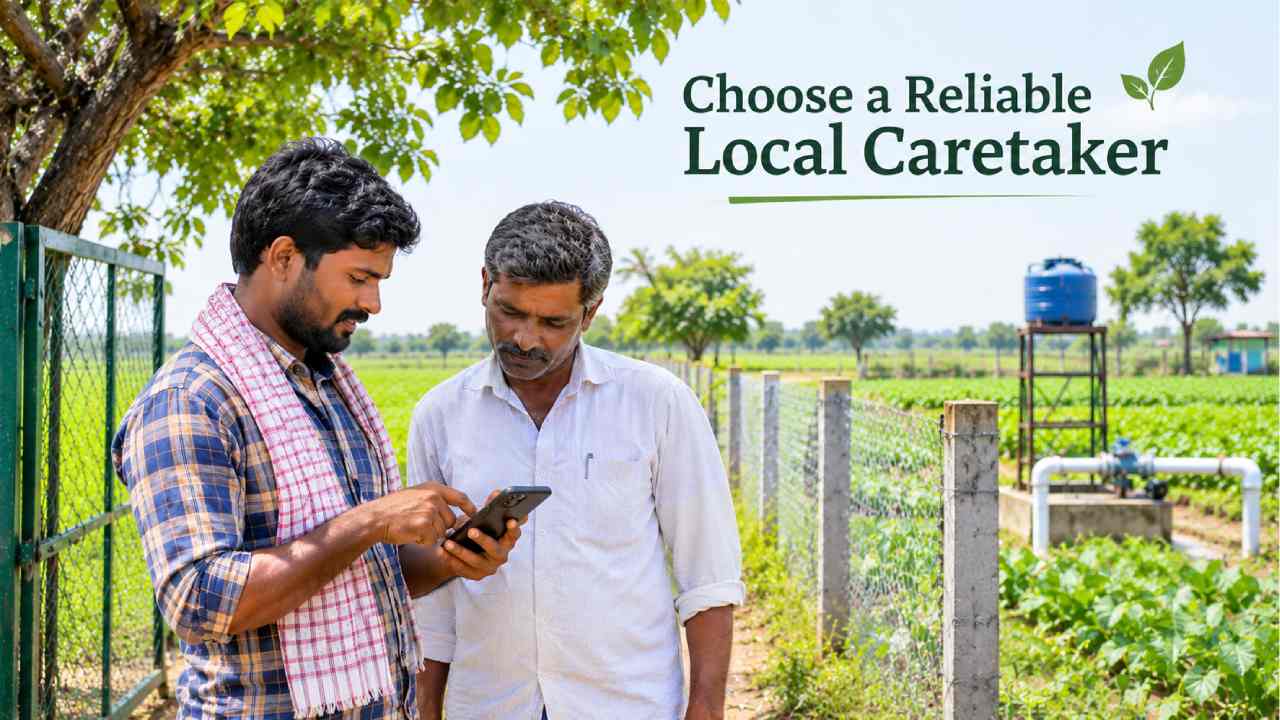
One of the most important decisions is choosing the right person to look after the property.
A local caretaker can help with routine inspections and report problems before they become serious.
What should you look for in a caretaker?
- Someone who lives reasonably close to the property.
- A person who can visit the site when required.
- Basic knowledge of agricultural land maintenance.
- Clear communication through phone calls or WhatsApp.
- Willingness to share regular photos and updates.
- References from people who have worked with them.
Clearly define the responsibilities
Before appointing someone, prepare a simple list of duties:
- Visit the property according to an agreed schedule.
- Check fencing, gates and access points.
- Observe water sources and irrigation equipment.
- Report any unusual activity or damage.
- Share dated photos and short videos.
- Inform the owner before carrying out additional paid work.
It is also useful to agree on payment, working hours, emergency contact details and responsibilities in writing.
Do not hand over original property documents, blank signed papers or unrestricted authority to anyone looking after the land.
3. Remote Land Management: Monitor Fencing and Property Boundaries
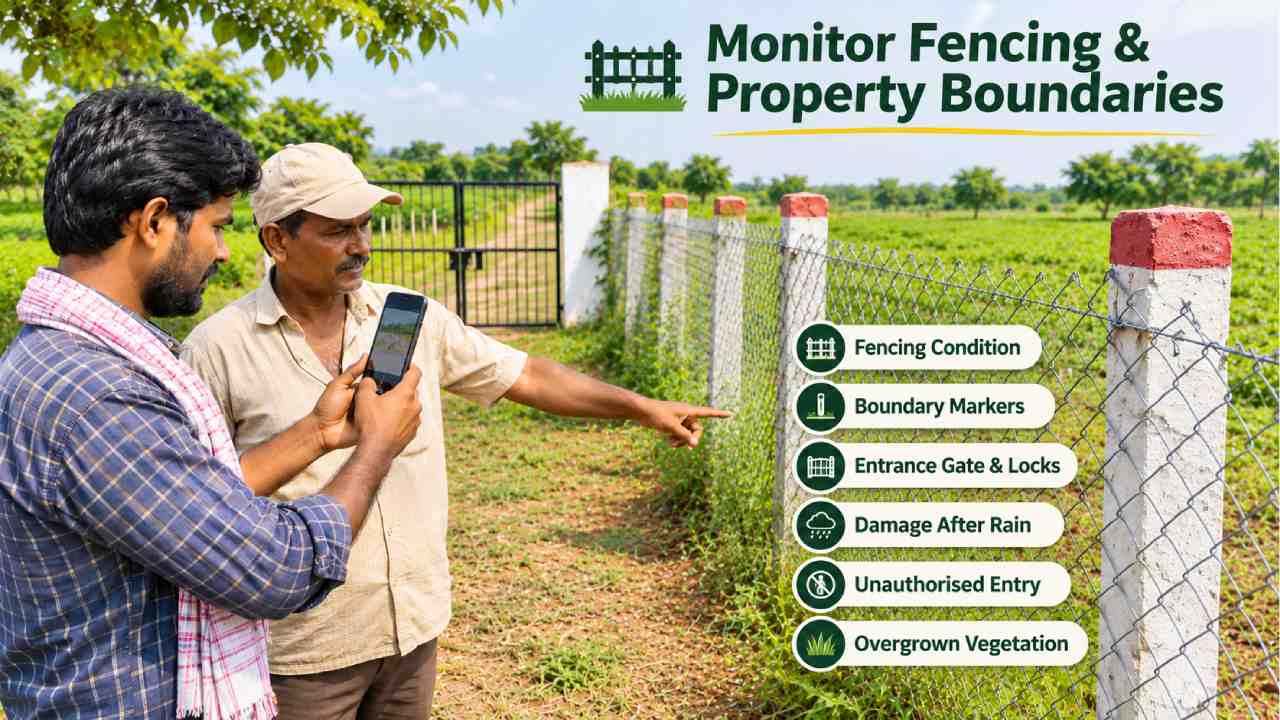
Fencing is an important part of protecting agricultural land, especially when the owner cannot visit frequently.
A damaged fence or open entrance can make the property vulnerable to unwanted entry, animals and other problems.
Important things to monitor:
- Condition of barbed wire or chain-link fencing.
- Boundary pillars and survey markers.
- Main entrance gate and locks.
- Damaged fencing after heavy rain or storms.
- Signs of unauthorised entry.
- Overgrown vegetation near the boundary.
Take photographs of the property boundaries from different sides and maintain them as a reference.
For important boundary concerns or disputes, do not rely only on photographs. Consult a licensed survey professional or the relevant revenue authorities for proper verification.
A caretaker can report visible changes, but should not independently move boundary stones or make changes to property boundaries.
4. Remote Land Management: Check Water Availability and Irrigation
Water is one of the most important resources for agricultural land.
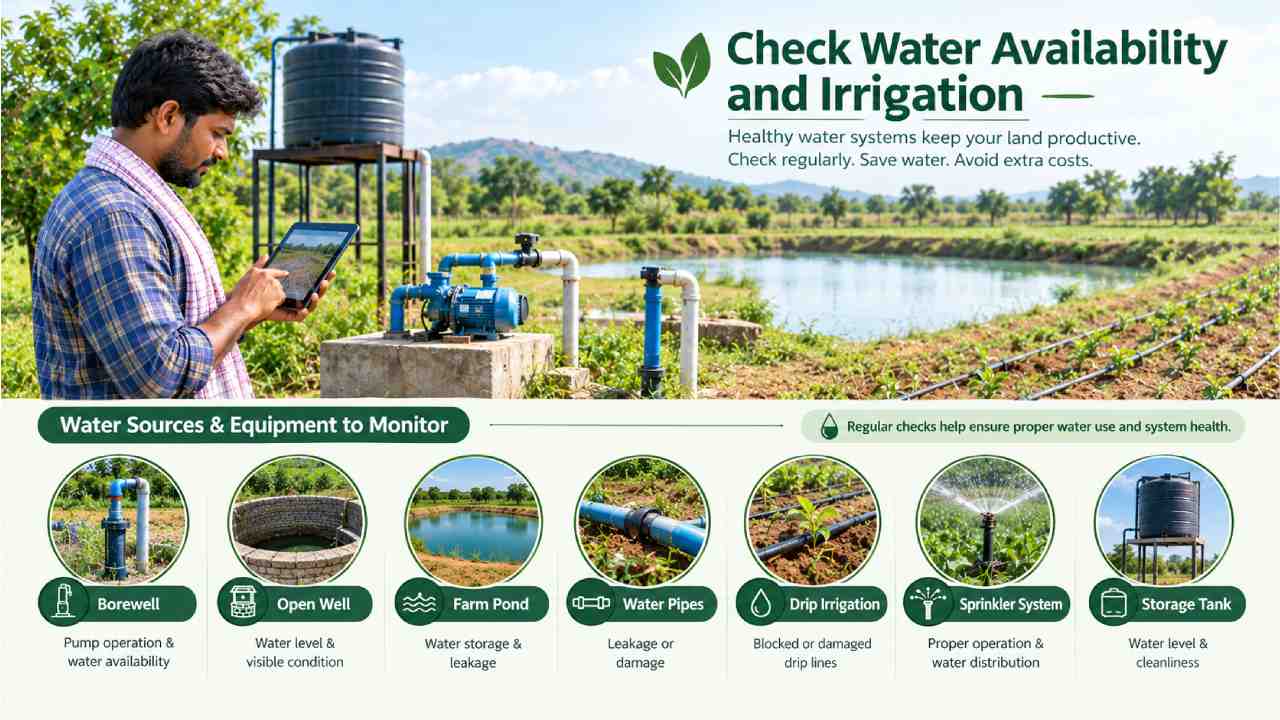
If the property has a borewell, open well, farm pond or irrigation system, its condition should be checked regularly.
What should landowners monitor?
| Water source or equipment | What to check |
|---|---|
| Borewell | Pump operation and water availability |
| Open well | Water level and visible condition |
| Farm pond | Water storage and leakage |
| Water pipes | Leakage or damage |
| Drip irrigation | Blocked or damaged drip lines |
| Sprinkler system | Proper operation and water distribution |
| Storage tank | Water level and cleanliness |
Where suitable, drip irrigation can help manage water more efficiently.
The Telangana Micro Irrigation Project explains that drip irrigation helps supply water according to plant requirements and supports moisture management. It can also reduce water loss through runoff and evaporation.
However, irrigation systems should be selected according to the crop, soil, water source and site conditions.
For a property that is not under cultivation, routine checks of the pump, pipes and water source may be sufficient. Avoid unnecessary water or electricity expenses.
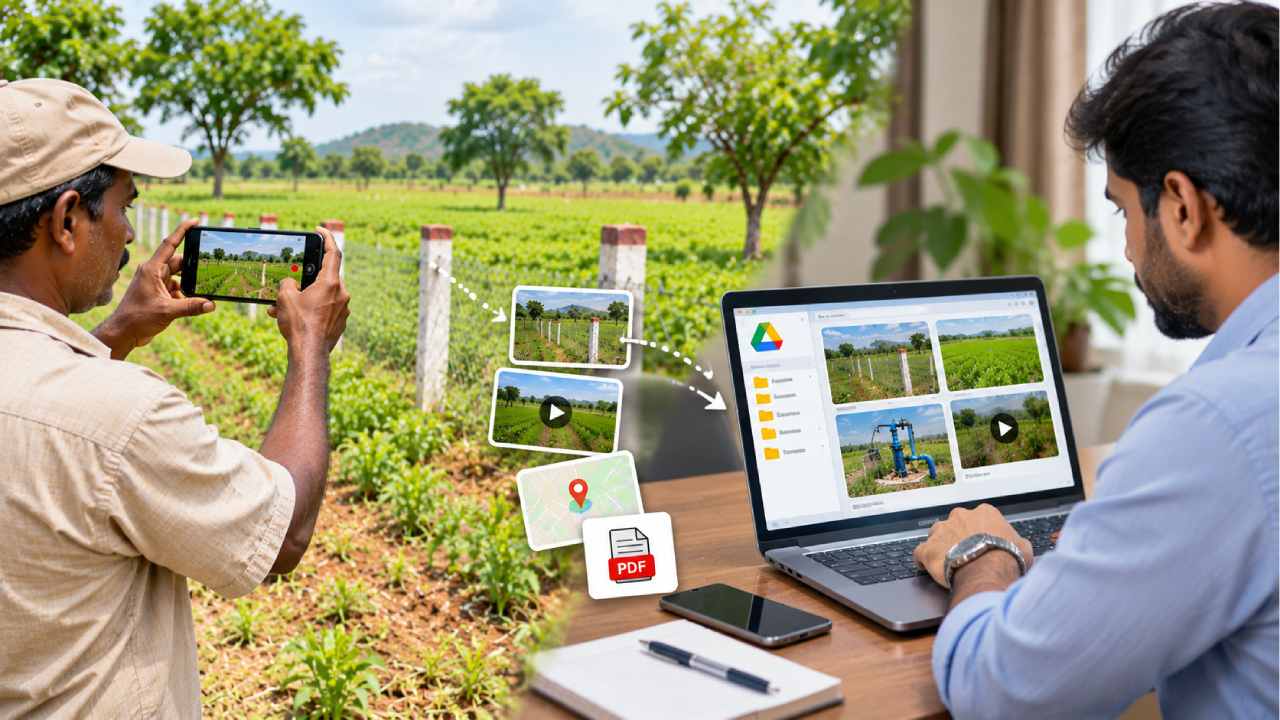
5. Remote Land Management: Use Photos, Videos and Digital Records
Technology makes it easier to stay connected with a property, even when the owner is not physically present.
A smartphone and a simple record-keeping system can make regular supervision much easier.
Useful practices include:
1. Weekly or Scheduled Photos
Ask the caretaker to send photographs of the entrance, boundaries, water source and overall land condition.
2. Short Site Videos
A short video showing the complete property can help the owner understand its current condition better than a few individual photographs.
3. Location Details
Where possible, ask for location-tagged photographs or a shared map location. These help identify the area being photographed but should not be treated as legal boundary proof.
4. Digital Records
Maintain a Google Drive folder for each property containing:
- Property code and location.
- Land extent and survey number.
- Original property documents.
- Fencing and maintenance photographs.
- Water source details.
- Caretaker contact information.
- Maintenance expenses.
- Inspection dates and reports.
5. Maintenance Expense Tracking
Record every expense with its date, purpose, amount and supporting bill or receipt.
These simple practices make Remote Land Management easier to organise and help owners maintain a clear record of what is happening on their property.
6. Remote Land Management: Schedule Regular Physical Inspections
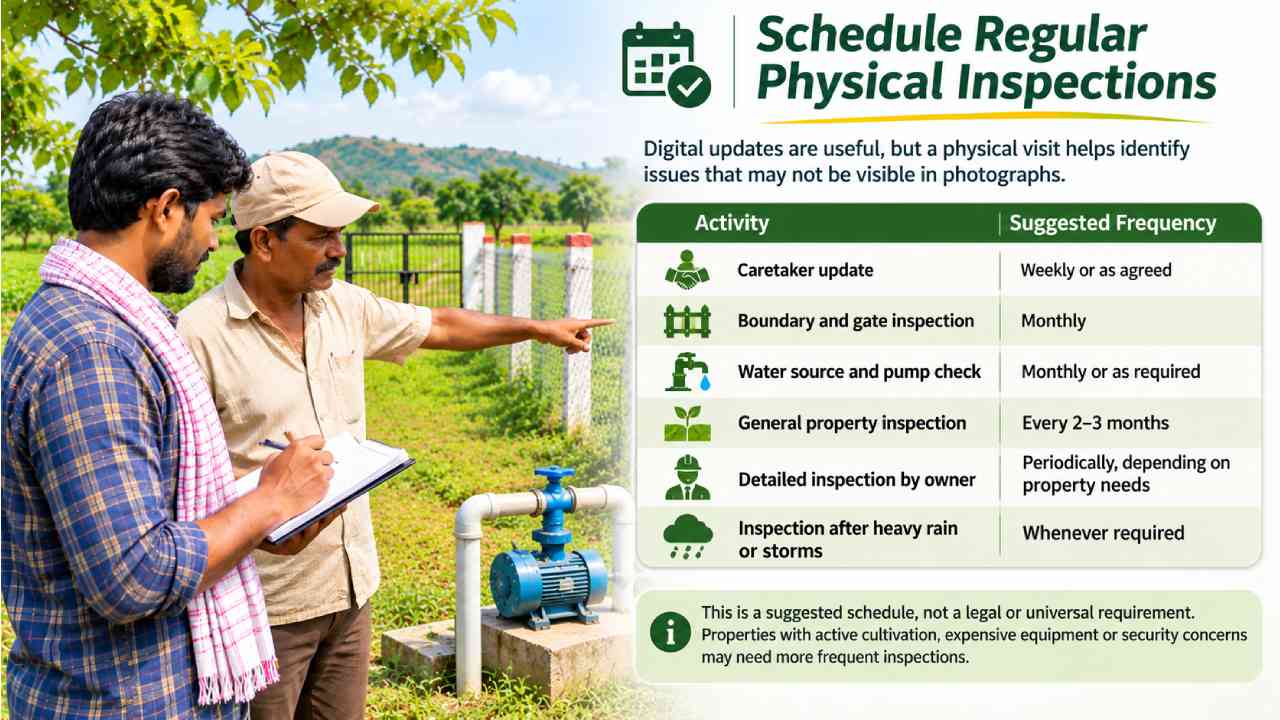
Even with a caretaker, photographs and digital records, the owner should not depend entirely on remote updates.
A physical visit helps identify problems that may not be visible in photographs.
For example, a photograph may show a borewell pump, but it cannot always confirm the actual water yield or the condition of the entire irrigation system.
A practical inspection schedule can look like this:
| Activity | Suggested frequency |
|---|---|
| Caretaker update | Weekly or as agreed |
| Boundary and gate inspection | Monthly |
| Water source and pump check | Monthly or as required |
| General property inspection | Every 2–3 months |
| Detailed inspection by owner | Periodically, depending on property needs |
| Inspection after heavy rain or storms | Whenever required |
This is a suggested schedule, not a legal or universal requirement. Properties with active cultivation, expensive equipment or security concerns may need more frequent inspections.
7. What Technology Can Help with Remote Property Monitoring?
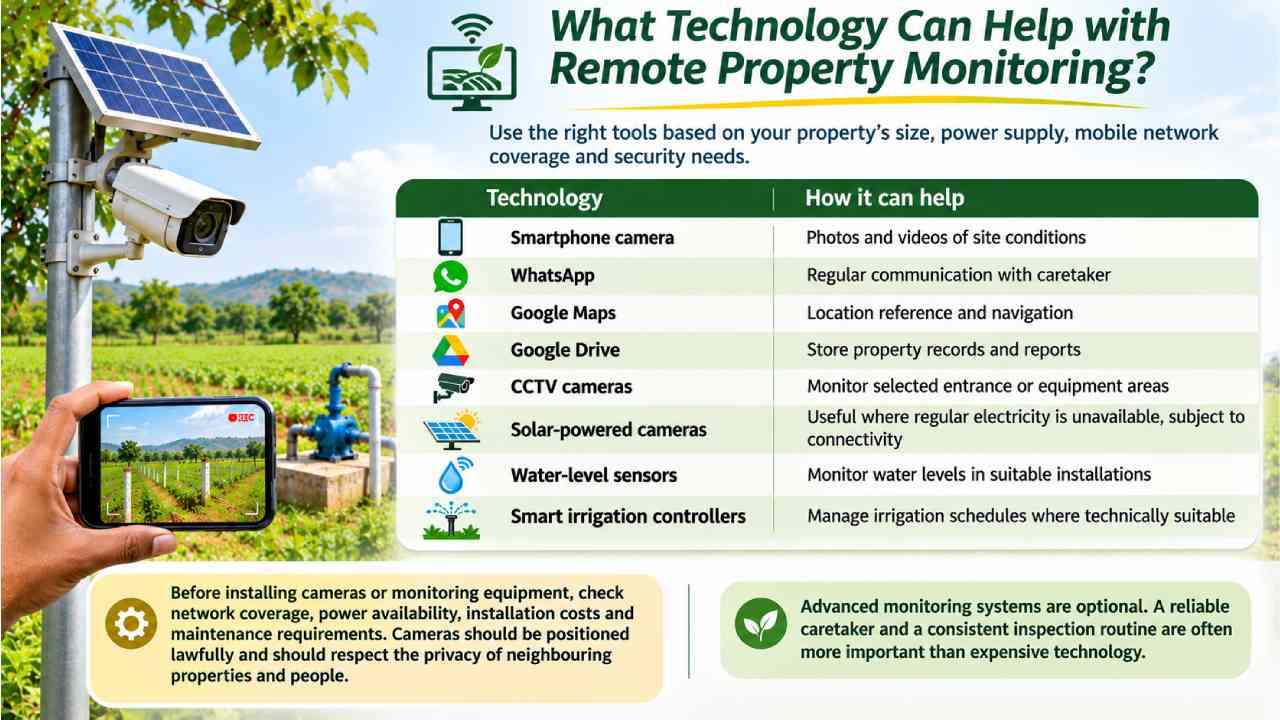
Technology can make supervision easier, but not every property needs expensive equipment.
Choose tools based on the property’s size, electricity availability, mobile network coverage and security requirements.
| Technology | How it can help |
|---|---|
| Smartphone camera | Photos and videos of site conditions |
| Regular communication with caretaker | |
| Google Maps | Location reference and navigation |
| Google Drive | Store property records and reports |
| CCTV cameras | Monitor selected entrance or equipment areas |
| Solar-powered cameras | Useful where regular electricity is unavailable, subject to connectivity |
| Water-level sensors | Monitor water levels in suitable installations |
| Smart irrigation controllers | Manage irrigation schedules where technically suitable |
Before installing cameras or monitoring equipment, check network coverage, power availability, installation costs and maintenance requirements. Cameras should be positioned lawfully and should respect the privacy of neighbouring properties and people.
Advanced monitoring systems are optional. A reliable caretaker and a consistent inspection routine are often more important than expensive technology.
8. Common Mistakes to Avoid When Managing Land from a Distance
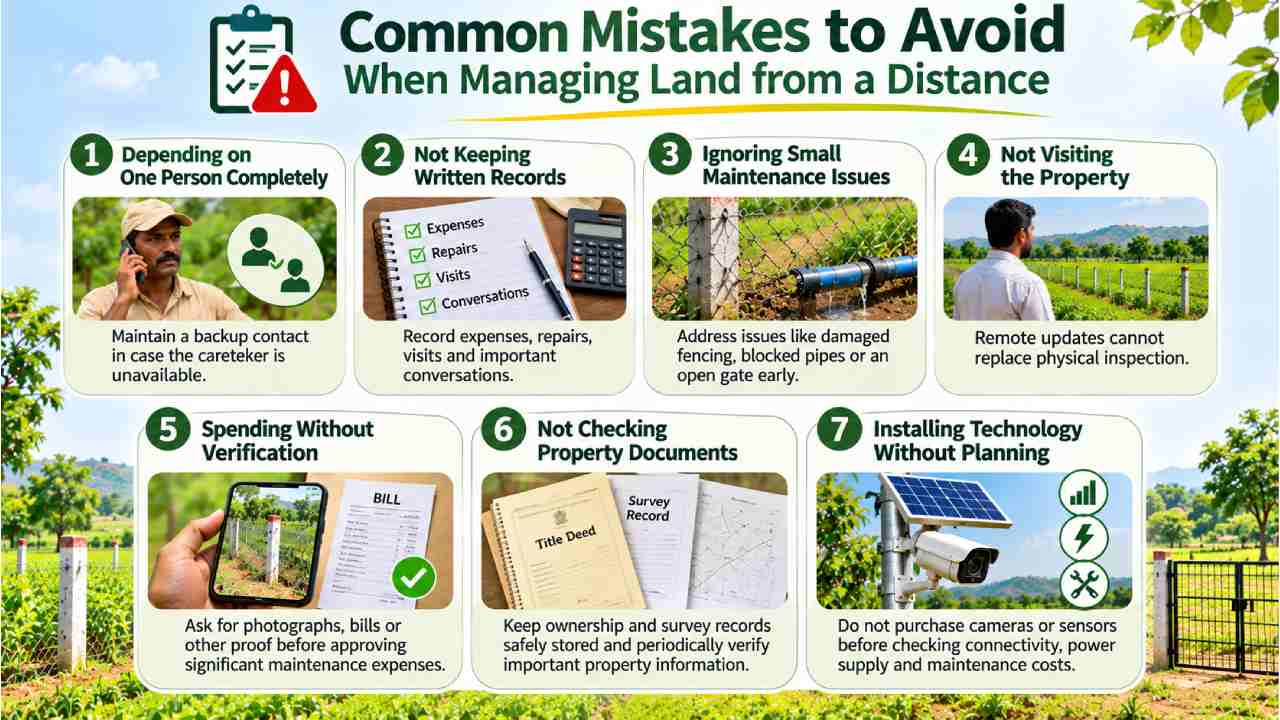
Even well-planned properties can face problems when owners do not have a clear management system.
Avoid these common mistakes:
1. Depending on One Person Completely
Maintain a backup contact in case the caretaker is unavailable.
2. Not Keeping Written Records
Record expenses, repairs, visits and important conversations.
3. Ignoring Small Maintenance Issues
Damaged fencing, blocked pipes or an open gate should be addressed early.
4. Not Visiting the Property
Remote updates cannot replace physical inspection.
5. Spending Without Verification
Ask for photographs, bills or other proof before approving significant maintenance expenses.
6. Not Checking Property Documents
Keep ownership and survey records safely stored and periodically verify important property information when necessary.
7. Installing Technology Without Planning
Do not purchase cameras or sensors before checking connectivity, power supply and maintenance costs.
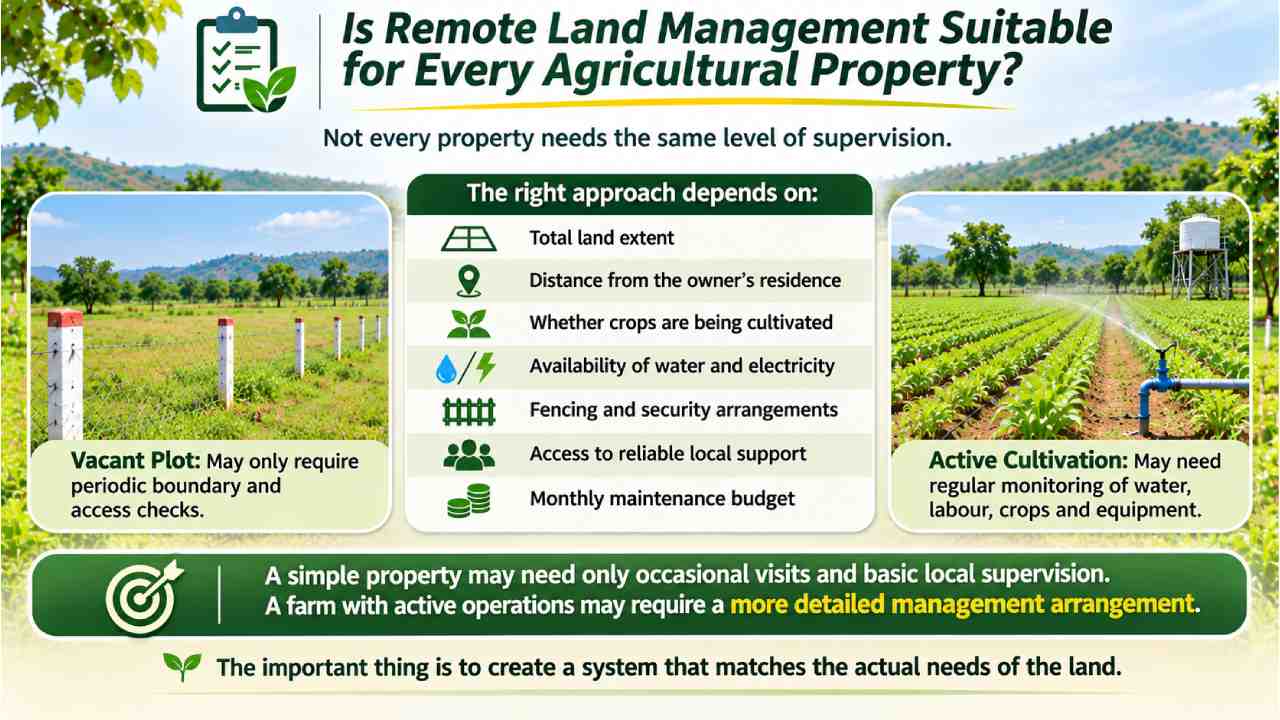
9. Is Remote Land Management Suitable for Every Agricultural Property?
Not every property needs the same level of supervision.
A vacant agricultural plot may only require periodic boundary and access checks. A property with active cultivation may need regular monitoring of water, labour, crops and equipment.
The right approach depends on:
- Total land extent.
- Distance from the owner’s residence.
- Whether crops are being cultivated.
- Availability of water and electricity.
- Fencing and security arrangements.
- Access to reliable local support.
- Monthly maintenance budget.
A simple property may need only occasional visits and basic local supervision. A farm with active operations may require a more detailed management arrangement.
The important thing is to create a system that matches the actual needs of the land.
Conclusion
Owning agricultural lands should not become difficult simply because you live in another city.
With reliable local support, proper fencing, regular water checks, digital records and planned physical inspections, owners can stay informed about their property even when they cannot visit frequently.
Remote Land Management is not about controlling every activity from a distance. It is about creating a simple and dependable system to protect the property, monitor its condition and make informed decisions.
At Bhoomi Infrastructure, we believe that understanding the responsibilities of land ownership is just as important as choosing the right agricultural property.
Sources and References
- Government of Telangana – Agriculture and Co-operation Department.
- Telangana Micro Irrigation Project – Department of Horticulture.
- ICAR – Central Research Institute for Dryland Agriculture, Hyderabad – Research on harvested water and natural resource management.
- Government of India – Krishi Mapper, agricultural land geo-tagging and monitoring.
Disclaimer: This article provides general educational information. Caretaker arrangements, property security, irrigation systems and maintenance requirements should be planned according to the property’s actual conditions and applicable rules.